


VIMS Sea Turtle Research Program
A project of VIMS Sea Turtle Research Program in conjunction with the partners and sponsors detailed below.
Subscribe to receive daily project updates
| Name | Species | Life Stage | Release Date | Last Location | Days Transmitted |
|---|---|---|---|---|---|
| 11583 | Loggerhead | Sub-Adult | 2003-07-15 | 2007-05-30 | 1415 |
| Billie | Loggerhead | Sub-Adult | 2005-08-30 | 2006-03-27 | 209 |
| Camden Adult MALE | Loggerhead | Adult | 2005-11-01 | 2006-08-09 | 281 |
| Cedar | Loggerhead | Sub-Adult | 2005-08-30 | 2006-06-18 | 292 |
| Coral Kate | Loggerhead | Juvenile | 2003-10-22 | 2003-11-27 | 36 |
| Delta | Loggerhead | Sub-Adult | 2004-11-16 | 2005-08-06 | 263 |
| Dewey "Rocky" Decimal | Loggerhead | Sub-Adult | 2005-06-17 | 2007-07-28 | 771 |
| Elvira | Loggerhead | Sub-Adult | 2005-06-17 | 2006-01-03 | 200 |
| Stinky Pete | Loggerhead | Juvenile | 2003-10-22 | 2003-11-06 | 15 |
| Yellow Lk | Kemp's Ridley | Juvenile | 2003-08-14 | 2004-07-17 | 338 |
Click on an animal's name for maps and more information.

Introduction
|
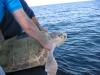
The Sea Turtle Stranding and Research Program at the Virginia Institute of Marine Science (VIMS) has monitored over 30 sea turtles, including loggerheads, Kemp's ridleys and leatherback sea turtles with satellite telemetry since 1985. These tracking data have provided valuable information regarding the at-sea movements of nesting and foraging sea turtles within Virginia?s waters.
The U.S. Army Corps of Engineers (ACOE) has utilized hopper dredges off the coast of Virginia to obtain sand for placement on oceanfront beaches along Virginia Beach or to maintain shipping channels within the Chesapeake Bay. Hopper dredging and beach nourishment are activities that have the potential to adversely affect sea turtles, either directly by encounters with dredging equipment or indirectly by alteration of nesting habitat (Coston-Clements and Hoss, 1983). This potential threat can be minimized by gathering life history data on the sea turtles inhabiting Virginia's waters and nesting along the shoreline. For over ten years, with the assistance of the ACOE, VIMS has satellite tracked nesting adult loggerheads and juvenile foragers in order to identify critical migration windows, assess sea turtle diving behavior in the vicinity of the ACOE dredging operations, and to evaluate the success of trawl relocation efforts.
VIMS has also maintained a mark and recapture program in cooperation with local fishermen since 1979. These data provide insight into the movements and feeding patterns of juvenile sea turtle utilizing the Chesapeake Bay as seasonal foraging grounds. In recent years, it has become apparent that many of these turtles spend time within both Virginia and North Carolina's waters. Some of these turtles are originally found as strandings and have required some level of rehabilitation by local facilities. Satellite telemetry provides a unique opportunity to evaluate the successes of these rehabilitation efforts over time.
Project Partners
VIMS works in cooperation with the Virginia Aquarium Stranding Team and volunteers.


Project Sponsors
Funding for VIMS satellite tracking projects comes from the Army Corps of Engineers, Norfolk Division, the National Oceanic and Atmospheric Administration, Cooperative Marine Education and Research Program (CMER), the Environmental Protection Agency Science To Achieve Results (EPA STAR) Fellowship Program and the SEASPACE Scholarship program.


