


Distribution of green sea turtles in the South Atlantic Bight
A project of SCDNR/MRD/MRRI in conjunction with the partners and sponsors detailed below.
Subscribe to receive daily project updates
| Name | Species | Life Stage | Release Date | Last Location | Days Transmitted |
|---|---|---|---|---|---|
| CM-JMA-2022-01-12-07 | Green Turtle | Juvenile | 2022-03-09 | 2022-04-24 | 46 |
| CM-JMA-2022-01-18-07 | Green Turtle | Juvenile | 2022-03-09 | 2022-06-28 | 111 |
| Coco | Green Turtle | Juvenile | 2021-10-20 | 2022-03-12 | 143 |
| Karen | Green Turtle | Adult | 2019-06-20 | 2019-08-31 | 72 |
| Mahon | Green Turtle | Juvenile | 2021-10-11 | 2021-11-21 | 41 |
| Raine | Green Turtle | Juvenile | 2021-10-04 | 2021-10-27 | 23 |
| Richard | Green Turtle | Juvenile | 2020-11-04 | 2021-07-19 | 257 |
Click on an animal's name for maps and more information.

Introduction
 |
Despite nearly exponential increases in green sea turtle nesting in Florida since the 1990's, coastal encounters of this species remain quite rare. For example, between 2000 and 2019, the SCDNR and the UGA MAREX/Sea Grant conducted nearly 8k trawling events during May through mostly July between St. Augustine, FL and Winyah Bay, SC, but only captured 21 individual sea turtles. By contrast, nearly 3k other sea turtles (90% loggerheads, 10% Kemp's ridley) were encountered.
Among 21 green sea turtles captured by the coastal trawl survey since 2000, 17 (81%) measured <35cm SCL, none measured between 35 and 80cm SCL, and one presumably adult male (85cm) and three adult females (>90cm) were also captured. The second largest female was also captured in Florida Bay as a juvenile in 1995 before being recaptured off Charleston, SC 20 years later. These observations collectively suggest connectivity between foraging habitats in the South Atlantic Bight (SAB) and other biogeographic regions further south, but clearly larger sample sizes are needed to better understand this connection.
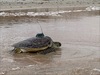
In addition to the lack of overall captures, the small size of green sea turtles also limited data collection. Blood samples were only collected for 12/21 green sea turtles for sexing (90% female; D. Owens) and 5/21 for genetics (80% CM-A01; J. Quattro). Permission to attach telemetry devices only began in 2017, and a transmitter deployed on the smallest female ("Karen") only recorded data for two months in 2019. A second transmitter will be deployed on a juvenile green sea turtle in November 2020, four months after "Richard" stranded on Daytona Beach and was subsequently rehabilitated at the University of Florida Whitney Laboratory Sea Turtle Hospital. "Richard" is a mid-sized juvenile that is infrequently captured by in-water surveys in the SAB, and hence the importance of tracking his movements, particularly during the winter months, and we are grateful to FWC, UF-Whitney Lab, and Dr. Daniel Evans (STC) for this amazing collaboration opportunity!
Beginning in 2021, collaborative research will also begin with the SCDNR Inshore Fisheries (aka, RecFin) Trammel Net Survey. This research survey accounts for nearly all incidental captures of green sea turtles by programs funded by NMFS SERO in the SAB, and for which basic data collection (tagging, genetics) plus more in-depth study (sex, nutrition, telemetry) was authorized by a 2016 Biological Opinion (BiOP). Given a similar size distribution of coastal green sea turtle captures encountered in the estuarine trammel net survey, we anticipate that acoustic telemetry data and physical tag recapture will provide the bulk of seasonal movement and residence pattern information. However, we hope that over the next decade we'll have additional opportunities to deploy satellite transmitters on this much less studied sea turtle species in the SAB as compared with loggerhead and Kemp's ridley sea turtles in recent decades.
