
Current Projects
Ascension Island
Darwin-Gabon
Northern Cyprus
Satellite Tracking
Completed Projects
Darwin-Anegada
Darwin-Cayman
Guinea Bissau
Little Cayman
TCOT
TUKOT

Ascension Island

Aims of the Project
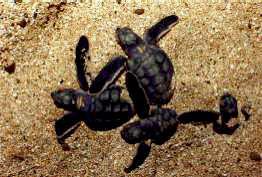
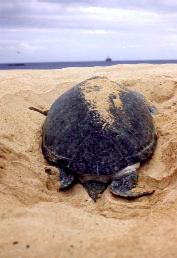 The marine turtle population breeding at Ascension Island (7º57'S, 14º22'W) is one of the largest in the Atlantic, with turtles migrating from distant feeding grounds along the South American coast to nest on the island's 32 beaches. Despite the international importance of this nesting colony, there has been no assessment of the size and status of the Ascension Island green turtle population since Dr. Jeanne Mortimer conducted a comprehensive survey in 1977/1978. While green turtles are protected on Ascension Island, there is concern over the future of this population for two reasons. Firstly, mortality on distant feeding grounds may have a large impact on the population size. Secondly, since the sex of green turtles is determined by the incubation temperature, there is a possibility that climate change may lead to production of hatchlings of only one sex.
1) To assess the current size of the Ascension Island green turtle population
 This will be accomplished by conducting beach surveys of all 32 of the Island's nesting beaches throughout each of the seasons 1998/99 and 1999/00.
Sand temperature will be monitored throughout the season on nesting beaches. Dead hatchlings will be collected from a large number of nests of known incubation temperature and the sex ratio of hatchlings will be ascertained by microscopic analysis of the gonads.
3) To assess the reproductive output by individuals
 Turtles are thought not to feed whilst at Ascension. The physical condition of individual turtles will be assessed throughout the nesting season and related to clutch size and frequency to help understand how the turtles
manage resources during the breeding season.
Turtles are thought not to feed whilst at Ascension. The physical condition of individual turtles will be assessed throughout the nesting season and related to clutch size and frequency to help understand how the turtles
manage resources during the breeding season.
While protected around Ascension, turtles may face numerous threats in their feeding grounds. By the use of satellite transmitters, individuals will be tracked to their feeding grounds.