
Nests Study
Monitoring the number of nests and nesting females in a population is not enough to know the status of that population. In fact, it is also important to quantify the productivity of those nests, that is, how many are reaching successful completion of the incubation process, and how many hatchlings emerge from them. Our nest success study is aimed at determining the hatching success on Gabon’s beaches, and the impact of various threats on our nests (including logs, predation, flooding and erosion). We are looking natural hatching success at various sites along the coast, and comparing it to nests relocated in protected hatcheries on the beach. The objectives of the Nests Study Task Force are to:
Estimate the success rate of incubation of natural nests of leatherback turtles and assess the impact of various threats on hatching success.
Conduct studies on leatherback reproductive biology and nest ecology.
Compare the productivity between nesting areas in Gabon and other countries on the Atlantic.
Evaluate methods of raising the productivity of Gabon’s beaches (transplantation into hatcheries) and assess habitat suitability along the coastline.
Build and improve the scientific training of Gabonese sea turtle technicians.
The success rate in hatcheries is generally higher than that of natural nests. In Gabon, predation and flooding ruin many natural nests. When nests flood, usually due to heavy rain, high tides or high water tables, the required levels of humidity and gas exchange are thrown off balance which causes eggs to rot. Insects and crabs also eat sea turtle eggs, as do monitor lizards, mongoose, and stray dogs. By transplanting the eggs to higher ground and protecting them with fencing that is crab-proofed by burying it a meter into the sand, well-placed hatcheries greatly reduce or eliminate the natural predation risks.
Nesting Success
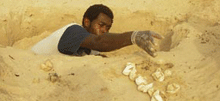
Part of our study is to estimate the success rate of incubation in natural nests. Here, Didier classifies eggs from an hatched nest as successful or unsuccessful.
Elevated Odds
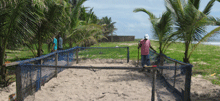
The success rate in hatcheries is generally higher than that of natural nests. In addition to greatly reducing or eliminating natural threats to nests, hatcheries also increase the chances of survival of hatchlings through supervised releases that protect them from the dangers of their race down the beach to the sea.
Turtle Team Member Profile:
Pierre Didier Agambouet

Didier has been working on Gabon Sea Turtle Partnership projects since 2008. He is meticulous in his attention to detail, and his dedication to his work is impressive.
In addition to traveling the Gabonese coast setting up hatcheries and studying nests, Didier also keeps things organised for the Partnership in Libreville, and always is ready with a great smile!
One by One
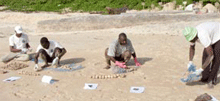
When eggs are transplanted, much care is taken to replace them into the hatchery nest in the same order and orientation that they were in the natural nest.
The Journey Begins
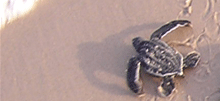
When a baby sea turtle emerges from its nest, it has a 1 in 1000 chance of surviving to adulthood! But the chances of a single egg making it that far are even smaller! The Nests Study Task Force is doing its part to raise those odds!
Did you know?
The sex of hatchling sea turtles is determined by the temperature in the nest during incubation. The pivotal temperature of 29-30 degrees produces approximately 50% males and 50% females, while lower temperatures produce males, and higher temperatures produce females! For this reason it is very important for hatcheries to maintain natural incubation conditions as closely as possible.