
-
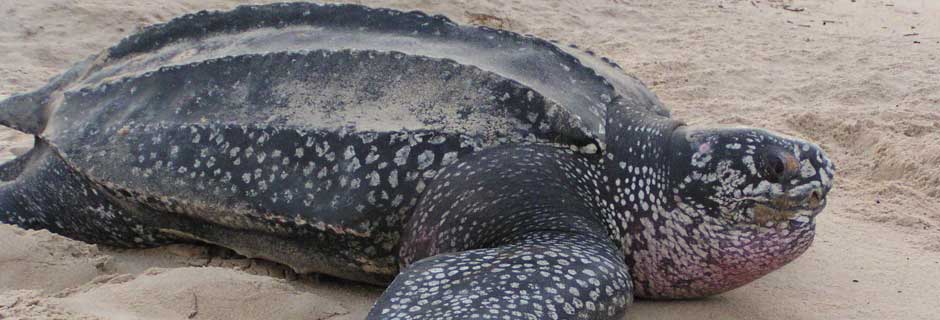
Leatherback
Leatherback sea turtles are the largest of all sea turtles; they can weigh as much as a small car! Their favorite food is jellyfish, which they can easily confuse with plastic bags floating in the sea. A major part of our education program involves informing people about the danger that pollution poses to sea turtles.
-
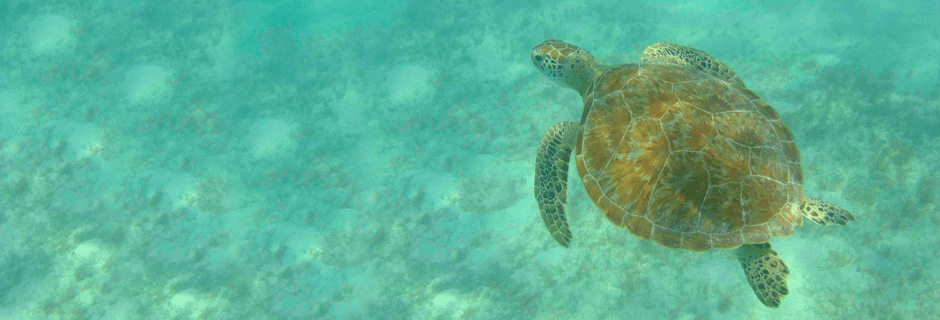
Green
Green sea turtles are found off the coast of Gabon in shallow rocky areas and in the Bay of Corisco. They were often hunted locally for their meat until people realized their numbers were greatly reduced and the population was in danger of extinction. We are working with local communities to find ways to reduce demand and to generate alternative income activities.
-
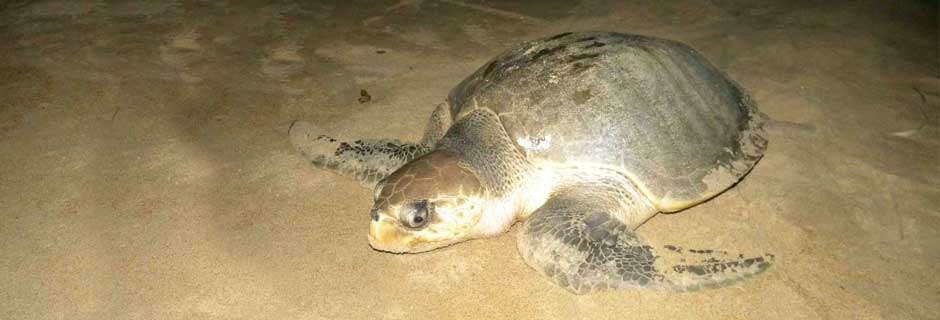
Olive Ridley
The smallest of Gabon’s sea turtles, olive ridleys sometimes nest in large groups known as "arribadas". However in Gabon, they nest individually, and are found primarily in Mayumba National Park, near the southern border of Gabon. Because they share their favorite preys with fishermen they are often caught incidentally in fishing nets and drown.
-
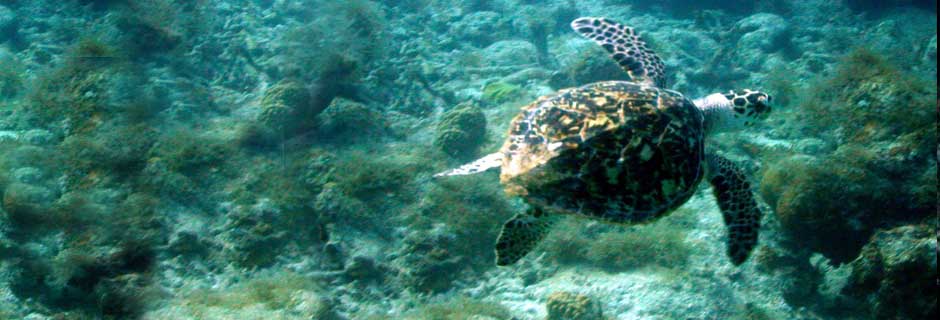
Hawksbill
Hawksbill turtles are named for the distinctive beak that they use to feed on sponges and corals. Like green turtles, they are also found primarily in Corisco Bay, near the northern border of Gabon. They are among the most endangered of all marine turtle species worldwide because of their beautiful carapace.
What is a Sea Turtle?
Sea turtles are ancient air-breathing reptiles, existing on earth since 110 million years ago! There are 7 species in the world, found in all oceans, in warm tropical and even cold arctic waters. Four species occur in Gabon: leatherbacks, green turtles, olive ridleys and hawksbills. All of these species are in danger of extinction worldwide, their numbers are declining sharply and might soon disappear unless we work together to protect them.
Sea turtles are not like land or freshwater turtles; they are not able to retract their head into their shell (the top part of the shell is called carapace and the bottom is the plastron). The front flippers are very strong and used for swimming, by flapping them up and down in the water, almost like wings. The rear flippers are used as a kind of rudder. Dark coloration on top and light coloration on the bottom help to protect the turtle from predation by reducing its visibility in the water. Instead of teeth sea turtles have jaws similar to beaks, often with very sharp edges for tearing their food.
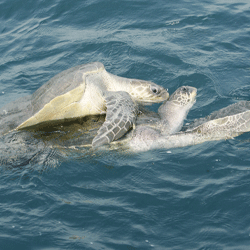
There is still a lot we don't know about sea turtles. For instance, there is no way to determine the exact age of a turtle; we think they may reach 80 years old in the wild. Also, it is not possible to distinguish between males and females until they approach sexual maturity, when the males develop long tails. In most species, males also have long curved claws, which may help in grasping the females' shells during mating.
Depending on their diet, sea turtles can be found in habitats as varied as coral reefs, seagrass beds, coastal shallows and the open ocean. They leave these feeding areas every 2-3 years to travel thousands of kilometers to the beaches where they were born in order to reproduce. Also, females often return to the same nest site as previous seasons with remarkable precision!
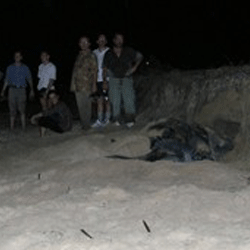 Female sea turtles come ashore at night to lay their eggs, several times in one season, while males remain offshore of nesting beaches where mating takes place. Females lay around 100 eggs in each nest, covered in a flexible leathery shell, not brittle like chicken eggs. During oviposition, the turtle enters an apparent trance and is insensitive to disturbance. At this time it is safe to approach a nesting turtle to observe her quietly while she covers the eggs, camouflages the nest and returns to sea.
The nest incubates for approximately two months, buried in the sand. Incubation conditions like temperature, gas exchange and moisture play essential roles in hatching success. In addition, the temperature of incubation determines the sex of the baby turtles. Above 32 degrees the nest produces only females, below 28 only males. At around 29.5 the clutch is half male and half female.
At the end of incubation, hatchlings emerge from their shell by breaking out with a special temporary egg tooth. And they begin trampling in the egg chamber, shuffling the sand underfoot, slowly building the trapped air upward, and scrambling one on top of the other like a ladder. At the surface they wait for the sand temperature to drop, usually emerging at night or in the cool dawn hours.
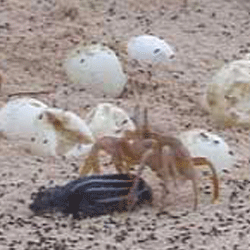 Nests and hatchlings unfortunately are easy victims of predation. Hatchlings dashing toward the sea are often eaten by ghost crabs, seabirds and monitor lizards. Sometimes nests are dug up by people or by domestic animals such as dogs or pigs. When hatchlings enter the sea, they are eaten by large fish, birds and even sharks. Even adult turtles can be attacked by sharks.
On the beach, hatchlings instinctively orient toward the brightest horizon, usually the sea with its night glow, and away from the dark shapes of dunes and vegetation. Bright lights can cause them to get lost and run inland instead of to the sea! Their dash down the beach is thought to be the time when they imprint on their native beach, so that they will return to the same place to reproduce as adults. When they finally reach the sea, hatchlings swim perpendicular to the waves, as fast as they can for several days, so as to get as far away from land and into the safer open ocean. This is known as the swimming frenzy.
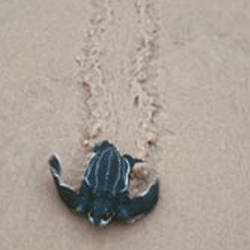 Very little is known about the following life stage, it is called the "lost years", but hatchlings are thought to ride the surface currents far offshore, travelling among driftlines and marine debris. After this developmental migration, larger juveniles of most species recruit to coastal feeding grounds, either specific to juveniles or with adults as well, usually originating from several different nesting populations. But, when they are ready to breed, they each head back to their native beaches. We still don't know how they are able to find the beaches where they were born after so many years and from thousands of kilometers away, but it is thought they can navigate using some sort of internal magnetic compass.
Gabon's Species: Leatherbacks
In the Pacific Ocean, leatherbacks have declined by 95% in the last twenty years; so the species has been classified as critically endangered worldwide. We are lucky that Gabon has the biggest nesting population in the world, but Gabon’s leatherbacks may also be declining. Leatherbacks are the largest of the sea turtle species and also the most unique-looking. They have a soft leathery carapace with seven longitudinal ridges and numerous white spots. A large adult can have a carapace of 180 cm in length, a flipper-span of 270 cm and a weight of 500 kg. The biggest recorded leatherback measured 2.91 m and weighed 916 kg!
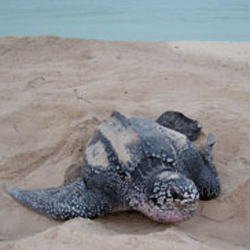 They feed on jellyfish and other oceanic invertebrates, which they trap in their oesophagus with special spiny structures. Floating plastic bags in the sea can be mistaken for jellyfish and kill leatherbacks who eat them. Leatherbacks can dive for as long as one hour to depths of as much as 1000 m! In addition, they are known to feed even in cold Arctic waters, since they are unique among reptiles in their ability to thermoregulate. Several leatherbacks which nested in Gabon and were marked with metal flipper tags were later recaptured in feeding grounds as far away as South America and South Africa.
Gabon's Species: Green Turtles
Green turtles are the only herbivorous sea turtles, feeding on seagrasses and algae in warm shallow coastal waters. Green turtle feeding grounds exist in only a few places around the world. Corisco Bay, on the border of Gabon and Equatorial Guinea, is the most important green turtle feeding ground in the Gulf of Guinea and studies have shown that green turtles come to feed here from many different nesting populations, even 10000 km away! Vice versa, individuals born on the same beach will not all feed at the same foraging ground. Another strange thing about the migratory nature of green turtles is that they do not necessarily feed at the foraging ground closest to their nesting beach, nor do they nest at the closest available beach to the foraging ground.
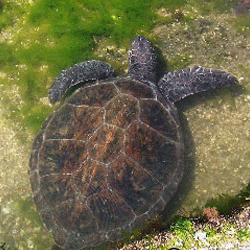 Foraging grounds with large numbers of turtles are, unfortunately, particularly vulnerable to exploitation. In Gabon, green turtles are sometimes the target of turtle hunting and may be found for sale illegally in Libreville markets and restaurants. Because they are extremely slow growing and have delayed maturity (they can take as much as 30-50 years to become adults), they cannot replace themselves fast enough and their population is declining rapidly. The depletion or disappearance of this population is likely to have serious consequences for the healthy functioning of their ecosystem.
Adults weigh between 100 and 200 kg and their carapace is around 100-115 cm long. Their colour is variable; the name actually derives from the colour of their body fat, a result of their vegetarian diet. Green turtles usually nest on isolated predator-free oceanic islands, as well as remote mainland beaches. During their long migrations from feeding to nesting grounds, they can survive for many months without eating.
Gabon's Species: Hawksbills
Hawksbills live in clear shallow waters among reefs or rocks, and are usually more sedentary than the other species. They feed primarily on sponges and corals, and have the extraordinary ability to remain unaffected by the potent toxins and spicules found in sponges. The most tropical of all species, it is also a solitary nester, preferring remote isolated beaches, often separated in space or time from other species. There are very few large nesting sites in the world.
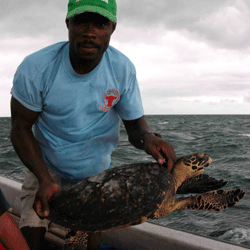 Hawksbills can also be recognized for their parrot-like beak. The carapace tends to be oval and with thick overlapping scutes, positioned a bit like the tiles of a roof. Unfortunately this beautiful shell is in high demand for the production of jewellery, glasses frames and other trinkets. Although, trade in these products is forbidden by international law, the hawksbill remains critically endangered worldwide.
In Gabon, hawksbills are found in Corisco Bay as foraging adults or developing juveniles; they also occasionally nest along the coast. Two hawksbills which had been marked with small metal flipper tags by a research project in Brazil, were recaptured in Corisco Bay after having travelled almost 5000 km.
Gabon's Species: Olive Ridleys
Olive ridleys have a carapace that is almost round, of an olive colour, and a relatively small size of approximately 60 cm in length and width; the adult weight is only about 35-50 kg. Olive ridleys live and feed in the open ocean and are rarely seen except when they approach the coast for nesting. In Gabon they are the second most common nesting species after leatherbacks. Unfortunately, olive ridleys often drown in the nets of trawlers, fishing in the same places where they find their prey of fish and small molluscs and crustaceans. Because of this vulnerability to capture by commercial fisheries, we count a high number of dead strandings on Gabon's beaches every year.
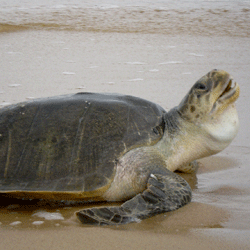 Interestingly, olive ridleys can nest in huge aggregations called arribadas, when as many as 150,000 females come ashore at the same time over the course of a couple of days. This however only occurs at a few sites in the world, such as Orissa (India) and Ostianal (Costa Rica).
Unfortunately, olive ridleys often drown in the nets of shrimp trawlers, fishing in the same places where they find their prey of fish and small molluscs and crustaceans. In recent years, the nesting populations in South America have declined dramatically, almost to extinction. For this reason, protection of the olive ridleys in Africa has become even more urgent.
 Did you know?
Baby sea turtles are called hatchlings. Just like nesting females, hatchlings use the brightest point on the horizon to find their way to the sea.
Light from buildings near the beach disorients them, as does light from flashlights or flash photography. Instead of going to the sea as they should, they head inland, where they can fall victim to predators or heat exhaustion.
To avoid this potentially fatal mistake, make sure to use either a red filter or a shade to keep white light from reaching nesting beaches, use a red filter on your flashlight, and always follow your guide's advice regarding flash photography in the presence of sea turtles.