
Conservation
It has been estimated that only 1 in 1000 hatchlings survives to adulthood! However, the chance of survival is probably even smaller if we consider all the human threats sea turtles encounter during their long lives in many different habitats.
On the beaches of Gabon, for instance, threats come from nest poaching by humans, domestic dogs eating eggs and hatchlings, vehicles driven on the beach crushing nests and making deep tracks on the sand, artificial light disorienting females and hatchlings trying to find the sea, erosion and other damage from construction along the coast, logs washing up on the beach and blocking and trapping nesting females and hatchlings.
Pollution and trash on the beach and in the sea are also threats, plastic can be ingested and can cause intestinal blocks, discarded fishing gear can cause turtles to become entangled and lose their flippers, toxins, oil or other chemicals can make sea turtles sick or stick to their bodies, or it can destroy the ecosystems on which they depend for food.
Humans sometimes capture sea turtles intentionally for meat or for other products from their shells and skin. Indeed, turtles are a source of protein and income for many coastal people who may need them to survive. Conservation projects are working hard to find a solution to this dilemma, alternatives to hunting that will allow both humans and sea turtles to live together and to benefit from a healthy marine ecosystem.
Perhaps the major threat to Gabon's sea turtles is the impact of commercial fisheries. These include both coastal trawlers and deep-sea fishing fleets. They fish at industrial scales, often in illegal zones or using illegal methods, with very little consideration for the resources they are exploiting, thus causing depletion of fishing stocks and sometimes catching many non-target species or damaging the sea bottom where they operate. Turtles are often bycatch of industrial fisheries, caught either by hooks or nets; they often drown and are discarded overboard. Conservation projects are trying to assess the impact of these activities and working with fisheries to implement methods (such as Turtle Excluder Devices) that will decrease sea turtle mortality.
An International Challenge
Sea turtles are highly migratory and difficult to study and protect; they spend 99% of their life at sea. Unfortunately, threats distributed over such vast habitats and long generation times are often difficult to identify and their impacts can seldom be directly correlated with declines in populations until it is too late.
In addition, during their life cycle sea turtles often cross international borders and also spend part of their lives in the high seas, where no countries have sovereignty. For these reasons their protection requires national and international cooperation; expensive conservation efforts in part of their range are useless, if the same turtles are hunted in another part of the range. For instance, a nesting beach might be protected locally at great expense, but the effort is meaningless if the same population is exploited when travelling to unprotected migration routes and foraging grounds. This has happened in Gabon, where green turtles that were born on a protected beach in the Indian Ocean arrived to feed in Corisco Bay after a journey of almost 10,000 km... but they were captured, slaughtered and sold!
Commercial Fishing
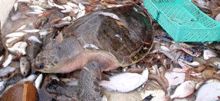
Sea turtles are often victims of commercial fishing vessels, even when they are not a targeted catch. Make smart seafood choices and help save sea turtle lives! Visit www.seafoodwatch.org to learn how!
Hunting and Sale

The development of alternative means of income can help turtle hunters change the way they earn their livings. You can also help by refusing to shop at stores that sell anything made from sea turtles.
How to Help:
- Don't kill or hurt turtles and don't buy turtle products!
- Don't dig up turtle nests or disturb nesting females and hatchlings.
- Don't throw garbage at sea or on the beach!
- Recycle and re-use everything you possibly can!
- Don't drive on the beach, make noise or use bright lights.
- Organize beach or town clean-ups in your area.
- If you see someone disturbing sea turtles, ask them to stop!
- If you eat seafood, make wise choices. There is an excellent sustainable seafood guide at www.seafoodwatch.org.
Major Threats
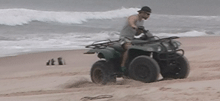
The beach is anything but relaxing for sea turtles! While we can't easily control wild animals' behaviour, we can make changes to our own. Reduce light pollution, and keep your quads and jetskis away from the nesting beaches.
Pollution
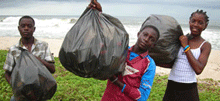
Help save a sea turtle: use canvas shopping bags instead of plastic ones, recycle and re-use whenever possible, and organize a beach or town clean-up today! Your everyday decisions really do make a difference!
Sea Turtles Rock!
After exploring our website, we hope you will agree with us that sea turtles are really COOL! Please help us protect them, tell your friends and family that sea turtles are not food, they are an essential and fascinating part of our environment. You can help sea turtles by following a few simple rules...