Fisheries
The most serious immediate threat to the survival of sea turtles worldwide comes from interactions with fisheries. In some instances, turtles are directly targeted by fisheries and are sold for meat. This used to be the case in the Corisco Bay area where locals frequently captured green and hawksbill turtles at sea (in their feeding areas) for traditional ceremonies or to sell for meat, principally in Libreville, or in Bata in Equatorial Guinea. At present, thanks to greater awareness and law enforcement, captures on the Gabonese side of Corisco Bay have virtually stopped. We do not know how many turtles are killed on the Equatorial Guinea side of the border, but we are working in close collaboration with the sea turtle conservation project there, Tomage.
On a global scale, far more sea turtles are killed accidentally through interactions with fishing activities, than those deliberately targeted. Captures of this sort are commonly known as ‘bycatch’ – a situation in which the turtles caught are not sought by the fishing crews, and are not taken as part of the catch.
Two of the most the most dangerous ways in which turtles are killed as bycatch involve trawl fishing, and long-line fishing. In Gabon, the shallow water, coastal trawler fleet targets demersal fishes and shrimp, using bottom trawl nets. These large conical nets are drawn through the water, capturing everything in their path. Turtles caught in the nets are frequently drowned as they are no longer able to reach the surface for air. Further offshore, in deeper waters, another type of vessel, the ‘long-liner’ catches tuna, shark, and other large predatory fish using immensely long monofilament lines that trail behind the vessel for as many as 50 kilometers. The line is hung with tens of thousands of baited hooks, which are, unfortunately, a great temptation to sea turtles, who are frequently caught. Both these fishing methods are classically ‘unselective’ in that any animal coming into contact with the fishing gear is likely to be caught, whether it is the desired catch of the vessel or not. Uncontrolled long-lining in the Pacific Ocean is thought to have been the principal cause of the leatherback sea turtle population there having been reduced by more than 90% in recent years. The same is likely to occur in the Atlantic Ocean if steps are not taken in time.
The Gabon Sea Turtle Partnership has recognized the severity of the threat from fisheries, and has prioritized actions to limit its severity. We are tackling bycatch in the trawl fishery in several ways. Firstly, many trawlers fish illegally within a 5.5km exclusion zone that protects coastal waters. Turtles are concentrated in these areas during the mating and nesting season and are subsequently extremely vulnerable to capture. The Partnership has supported the training of all turtle beach teams in methods for identifying and recording incidences of illegal fishing close to the coast. Reports by beach teams are then passed to the relevant authorities (Water and Forests Ministry, or National Parks).
To further minimize losses, the Partnership has been one of the main agencies aggressively promoting the adoption of Turtle Exclusion Devices (TEDS) within the Gabonese trawl industry. TEDs are simply large metal grills placed at an angle within the ‘sock’ or ‘cod end’ of the trawl net. On reaching the grill, a turtle is pushed downwards or upwards by the water pressure, and exits the net through a hole cut for that purpose at the base of the grill. Fish and shrimp continue through the bars and into the net to be caught, so only the large ‘bycatch’ is removed. Two in-depth at-sea trials of TEDS have been conducted, and several workshops held with the Gabonese Government. With NOAA we have brought over 20 TEDS into Gabon and are currently aiming to have these fitted to all shrimp vessels in the country. Discussions are also underway within the government in order to make the use of TEDs mandatory in the shrimp industry.
In collaboration with NOAA, the University of Exeter (UK) and the Gabonese government we are also helping to organise a training workshop for observers to be able to accurately collect bycatch data onboard Gabon’s fishing trawlers.
Smarter Seafood
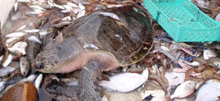
Sea turtles are often victims of commercial fishing vessels, even when they are not a targeted catch. Certain types of fishing are more harmful for endangered species than others. Make smart choices and help save sea turtles! Visit www.seafoodwatch.org to learn how!
Training
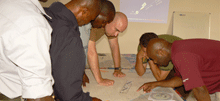
For two consecutive years, we have collaborated with the United States and Gabonese Navies to facilitate training workshops that develop capacity in fighting illegal fishing on the Gabonese coast.
A Second Chance
- Even turtles that are caught in trawl nets and appear to have drowned, can often be ‘reanimated’ through a special technique. Traditionally, these apparently dead animals were thrown back overboard, where they would then die. The Partnership has been active in providing information posters to all trawlers that can be pinned up on each vessel, and which detail the simple method required to allow these comatose turtles to revive and be returned alive to the water.
TEDs
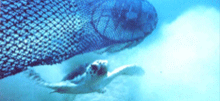
Turtle Excluder Devices, or TEDs, are an elegant and profitable solution to the problem of turtle bycatch in the Gabonese shrimp trawling industry. Pilot studies in Libreville have shown that these devices not only reduce or eliminate turtle bycatch, but also improve the quality of the target catch, which can be damaged when turtles are caught.
Busted!
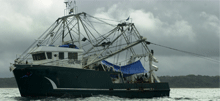
Aerial surveys undertaken by the Gabon Sea Turtle Partnership, combined with constant beach suveillance help inform authorities of illegal fishing infractions.
An International Problem
Bycatch losses through long-lining are harder to address than trawler fishing, as these ships do not dock or even approach the Gabon coast. However, by assisting with the efforts of Exeter University’s Turtle Conservation and Research Group in their satellite telemetry project, we are beginning to understand how and where turtle/fishery interactions take place in this context. Data on turtle internesting areas and migration routes is now being examined against data on long-line vessel presence obtained through the Gabon Government’s VMS (vessel monitoring system) program. Armed with such analyses, we hope that in the future, controls on fishing within certain areas or at certain key times of the year may be possible, thus reducing these potentially catastrophic losses.