
Erosion
Several of Gabon's beaches, like many around the world, are eroding. By comparing aerial photographs of the coast from 1983 and today, it was estimated that the Gabonese coastline has retreated an average of 100 metres. In addition to other possible causes, sea turtle nesting habitat may be disappearing due to rising sea levels worldwide, a phenomenon that is expected to continue, with sea levels rises of as much as 50 centimetres by 2100.
Although sea turtles spend only 1% of their lives on land during the nesting and nest incubation stages, it is a phase during which they are highly susceptible. In effect, the changing coastlines in nesting areas determine whether or not there are good conditions for nesting, incubation and hatching of eggs, in order to assure nest incubation success, and a future for the species.
Our Erosion Task Force has taken on an analysis of the evolution of geomorphologic parameters of turtle nesting areas in Gabon, combined with a study of the relation between these parameters and the process of nesting, incubation, and hatching success. To complete this study, the team studies coastal traits, cross-shore profiles, and sedimentary, meteorological, and hydrodynamic parameters.
Loss of Habitat
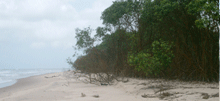
As sea levels rise and coastal profiles change, sea turtle nesting beaches are being swallowed up by other habitats, such as mangrove swamps.
What Future?
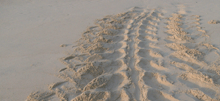
Global climate change is already affecting sea turtle nesting areas. The actions we take today will determine whether or not sea turtles will still exist in the future.
Collaboration
- We work in close collaboration with the Nests Study Task Force in order to analyze the relationship between coastal dynamics and nest success rates.
A Dynamic Coast
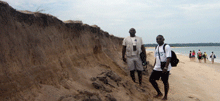
Dredging for sand near Libreville has affected the coastal dynamic in the area, causing dramatic erosion on Pointe Denis and Pongara.
Failed Nesting
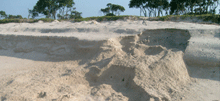
Erosion causes mini-cliffs like this one, which can prove to be insurmountable obstacles for sea turtles attempting to nest.
Pilot Study
We are currently undertaking a pilot study using a theodolite station in Pongara in order to regularly follow coastal dynamics throughout the year.