
Beach Monitoring
The members of Gabon's Sea Turtle Partnership carry out monitoring and surveillance at seven different sites along the coastline, covering almost 60 km of beach from mid-October to mid-April. These sites include two in Pongara National Park, one in Loango National Park, one in Gamba and three sites in Mayumba National Park. The goal of the Partnership is to standardise our monitoring and habitat protection at all these sites so that we can have uniform data-collection and rigorous results. Each field team is composed of highly trained technicians with necessary supplies and equipment for:
Night monitoring of nesting females and daytime surveillance against threats on the nesting beach and inter-nesting habitat;
Measuring, tagging and sampling of all turtles encountered, including nesting females, juveniles or strandings;
Data-collection on abundance and distribution of nesting for all species;
Data-collection on nest incubation and hatching success of nests in the wild or nests relocated to beach hatcheries for protection;
Addressing threats, such as logs, predation, poaching, erosion, flooding, artificial lights, pollution, oil spills, inappropriate beach use and illegal fisheries.
Camp Life
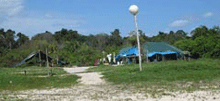
We open our research camps each year from October to mid-March, so that we can protect and study sea turtles over the entire nesting season. Our camps protect over 60 km of Gabon's beaches!
Specialists
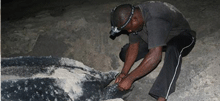
Each turtle team technician undergoes yearly training at a 3-day workshop, learning skills like biometric and genetic sampling, species and track identification, photography, tagging, and record keeping. Many of our team members have been working on the nesting beaches for over 5 years!
Turtle Team Member Profile:
"Papah" Guy Makanga

Before Papah began working as a park ranger, he was a locally renowned hunter who specialized in killing elephants that had raided villagers' plantations.
Papah brings his expertise in the wildnerness to his new vocation- protecting wildlife. He is one of the original four park rangers in Mayumba, and has been protecting sea turtles and Mayumba National Park's other flora and fauna since 2004.
A Helping Hand
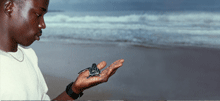
When turtle team technicians encounter hatchlings on their way to the ocean, they often help out by keeping predators away. But they also know that the tiny turtles need to crawl across the sand before they enter the water; it's part of the learning process that will help them find their way back when they are old enough to reproduce!
Walk On
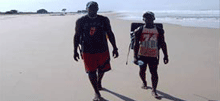
Turtle teams walk as much as 15 km per night, even if it's raining! It's a tough job, but worth it. Since nightly patrols were established, nest raiding by egg thieves has dropped to ZERO!
Did you know?
The highest density of nesting leatherback turtles on Earth is in Gabon, at the far southern end of Mayumba National Park!