 |
| Various other methods have been tried to uniquely mark turtles. Some have had better success than others, and probably more methods have been tried. If you have tried a method to mark a turtle that is not mentioned here, please contact us at tagging@seaturtle.org with the details so we can include it here.
|
|
Carapace tagging.
- The use of paint or some other ephemeral marking system is often used as a temporary system to recognize turtles on the same night or perhaps over the course of a week. The paint usually wears off after a few days, although it can be reapplied at regular intervals for longer use.
- Attachment of a wire or metal plate to the carapace by means of glue or drill holes. Although these last longer than paint, they are still not permanent, either because of the way the carapacial scutes grow outwards or because the glues or attachment bolts are not permanent in the marine environment.
- Drill holes. Some projects have placed unique patterns of shallow drill holes at the caudal end of the carapace for unique identification. These holes are not permanent because of the way that scutes grow outwards, but this method may be complementary to another system of tagging.
- Branding. This has been attempted on leatherback carapaces. The results have been limited and there is no evidence that the scars remain visible on a scale of several years.
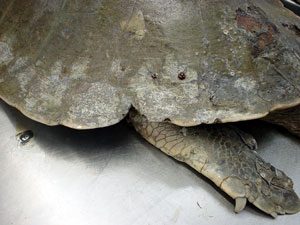 Carapace notching. Some workers have put notches in the edges of carapaces to identify turtles, often when the turtles are still hatchlings. Although notches can be used sometimes to successfully reindentify some turtles, it is possible that notches seen on adult turtles are naturally induced (either by shark bites, accidental collisions with boats, etc). Also, there are only a limited number of notch site combinations, making it difficult to uniquely mark a large number of turtles. Carapace notching. Some workers have put notches in the edges of carapaces to identify turtles, often when the turtles are still hatchlings. Although notches can be used sometimes to successfully reindentify some turtles, it is possible that notches seen on adult turtles are naturally induced (either by shark bites, accidental collisions with boats, etc). Also, there are only a limited number of notch site combinations, making it difficult to uniquely mark a large number of turtles.
Natural unique identifiers
- Scute patterns. Like most other animals, individual turtles have individual
patterns of scutes on their heads and flippers. By careful observation
and documentation, some workers have been able to reidentify turtles
by observation only. The successful use of this requires much investment
of time and effort.
 Pink-spot
pattern on leatherback turtles. Each pink spot (or pineal spot) on the
head of a leatherback is thought to be unique in size and shape. Some
workers have successfully used photo-identification of leatherback heads
to identify turtles that had lost their flipper tags. This method requires
much investment of time and effort, and there is some evidence that
a leatherback's pink spot can change over time. Pink-spot
pattern on leatherback turtles. Each pink spot (or pineal spot) on the
head of a leatherback is thought to be unique in size and shape. Some
workers have successfully used photo-identification of leatherback heads
to identify turtles that had lost their flipper tags. This method requires
much investment of time and effort, and there is some evidence that
a leatherback's pink spot can change over time.
- Natural wounds or injuries. Some turtles have distinctive marks from
wounds or injuries, particularly leatherbacks. These individuals may
be easily distinguished by their scars or healed wounds. This method
has been used in particular for leatherbacks, whose flippers are easily
scarred in the natural environment. A drawback is that not all turtles
have visible scars or wounds, thus limiting the effectiveness of this
technique.
Chemical injections
- Oxytetracycline is an antibiotic that is absorbed by the bones around the time of injection. It can be used as a marker for some turtles, although it is not a unique identifier. It is best used as a marker for a specific age class or location of turtle. It is most easily detectable in full cross sections of bone, which is only possible to do after the turtle has died from other causes. It is possible to collect a biopsy of the bone from a living turtle, but it may be insufficient to detect the oxytetracycline.
Other internal tags
- Coded wire tags are small uniquely notched pieces of metal that are inserted in the flipper of turtles and either magnetized or not. They can be detected with a portable magnetometer, although the technique of properly identifying the presence of the coded wire tags can be tricky. They can also be detected by radiography. Once you have identified a turtle that has a coded wire tag, the only way to see the unique code is by surgically removing the tag. Because of this logistic challenge, most coded wire tags are removed only from turtles that have died from other causes. Nevertheless, the location (what flipper and where along the flipper) can be used to identify groups of turtles (e.g. age class), as has been done with Kemp's ridley turtles.
|


