| PIT
stands for Passive Integrated Transponder, and PIT tags are injected
internally under the skin or into muscle of sea turtles. About the
size of a grain of rice, the PIT tag consists of inert wire, a chip
and capacitor encased in glass. When a scanner is passed over the
site where the PIT tag was injected, the radio frequency of the scanner
will excite the PIT tag, which in turn will reflect the radio waves
back to the scanner. In this way, the scanner can detect the unique
alphanumeric code of the PIT tag. The main benefit of using PIT tags
for marking turtles is that the tag is nearly permanent (please note
that some loss of PIT tags does occur). The main drawbacks include
that it is expensive (about US$5.00 to $10.00 per PIT tag, while metal
flipper tags can cost as little as US$0.25 per tag) and a scanner
is required to detect to PIT tag. At the current time, there are two
main types of PIT tags that operate on different frequencies: Trovan
(Europe/Africa) = 128 kHz and Avid/Destron-Fearing (the Americas)
= 125 kHz. This means that some scanners may or may not be able to
detect all types of tags. Be sure to ask the distributor where you
buy the scanner if it can detect different kinds of tags. There is
ongoing discussion in the Radio-Frequency Identification Industry
about standardizing the frequency used by different manufacturers
in the future (134.2 kHz). |
|
|
|
The following table highlights some of the different properties of the two PIT tag systems used with sea turtles.
| PIT tag scanner | Main benefits | Main drawbacks | Other considerations |
| TROVAN | Can record scanned numbers in memory for download to computer | Cannot detect Avid-Destron tags. LID 500 scanner is not weatherproof | Injector system is better for larger turtles (injector needle has a wide gauge); often used on leatherbacks |
| Avid/Destron-Fearing | Can often also detect TROVAN PIT tags | Scanners are usually not weatherproof, and most do not store records in memory for download to computer | Wider variety of injection systems available, including those for smaller turtles |
The range of the scanners is usually limited to a few centimeters, so it would take time to scan the entire turtle for a PIT tag. Although this may not matter in cases where only one or two turtles are scanned at a time, it is problematic for nesting beaches with high density of nesting turtles. Also, some injection sites may be more prone to tag migration (when the PIT tag actually moves through the internal muscle or tissue to another location, such as the end of the flipper), which makes it more difficult to successfully find the tag. At the current time, there is little standardization of PIT tag placement across projects or countries. Here is a list of different sites that have been or are being used for PIT tag placement in turtles:
- Left or right shoulder muscle
- Left or right mid-flipper
- Left or right rear flipper
- Neck muscle
- Under the plastron
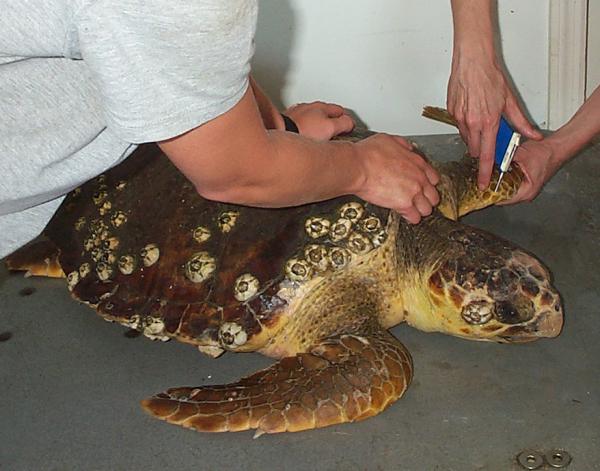 Although there are various reasons for choosing a specific site, the benefits from having a single standardized site for hardshelled turtles and leatherbacks are too great to ignore. Here are our suggested locations for PIT tag injection: Although there are various reasons for choosing a specific site, the benefits from having a single standardized site for hardshelled turtles and leatherbacks are too great to ignore. Here are our suggested locations for PIT tag injection:
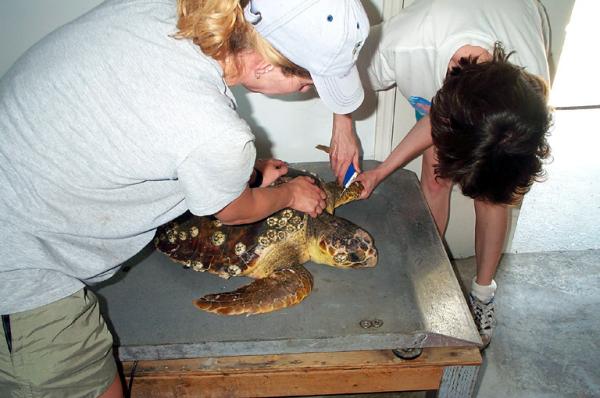 Hardshell Turtles: In the turtle's left front flipper, in the triceps muscle complex. When injecting into this site, we recommend that the injection needle be placed at a 15° angle from the skin prior to injection, to avoid accidentally hitting bone. Hardshell Turtles: In the turtle's left front flipper, in the triceps muscle complex. When injecting into this site, we recommend that the injection needle be placed at a 15° angle from the skin prior to injection, to avoid accidentally hitting bone.
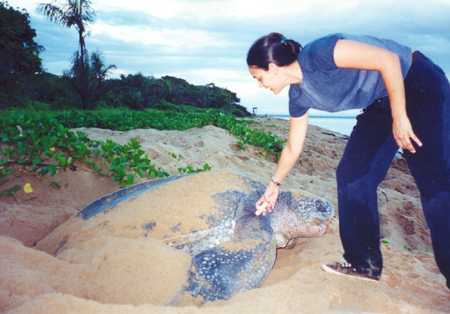
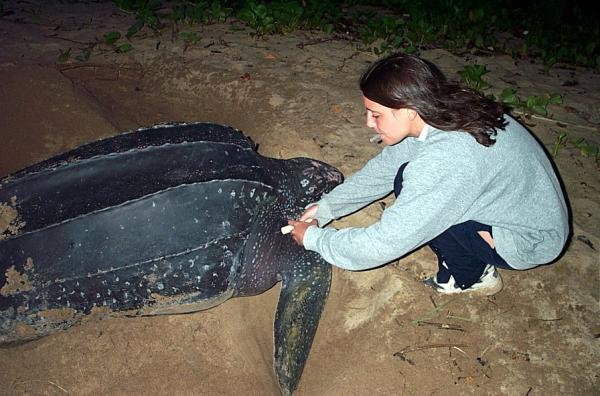 Leatherback Turtles: In the turtle's right front shoulder muscle. We recommend that the injection needle is placed at about 45° angle prior to injection, to minimize possible injury. Leatherback Turtles: In the turtle's right front shoulder muscle. We recommend that the injection needle is placed at about 45° angle prior to injection, to minimize possible injury.
PIT tags:
 At
the current time, Trovan PIT tags are not available for sale in the USA.
So, if you live in the USA, you can only purchase AVID/Destron-Fearing
PIT tags. One of the most commonly used AVID/Destron-Fearing PIT tags
is model number TX1406L, which comes in a sterilized package and loaded
into a single-use needle delivery system (you will also need the TX1406L
Sterile Injector to apply the tag). These are available in North America
from Biomark (http://www.biomark.com/products.html)
or in South American from ECISRL (http://www.ecisrl.com/productos/inyectores/inyectores.htm). At
the current time, Trovan PIT tags are not available for sale in the USA.
So, if you live in the USA, you can only purchase AVID/Destron-Fearing
PIT tags. One of the most commonly used AVID/Destron-Fearing PIT tags
is model number TX1406L, which comes in a sterilized package and loaded
into a single-use needle delivery system (you will also need the TX1406L
Sterile Injector to apply the tag). These are available in North America
from Biomark (http://www.biomark.com/products.html)
or in South American from ECISRL (http://www.ecisrl.com/productos/inyectores/inyectores.htm).
 Outside
the USA, you can purchase Trovan PIT tags from Trovan (http://www.trovan.com/).
The most commonly used Trovan PIT tag used on sea turtles is model number
ID100, which is also loaded into a single-use needle delivery system.
Don't forget that you will also need to have a plastic injector for proper
application. You will not have the opportunity to order PIT tags with
a specific alphanumeric code. The PIT tags have a 10 or 20 character code,
and are distributed randomly. There are more than 550 billion unique codes
available, so there is no chance of code duplication in PIT tags. Outside
the USA, you can purchase Trovan PIT tags from Trovan (http://www.trovan.com/).
The most commonly used Trovan PIT tag used on sea turtles is model number
ID100, which is also loaded into a single-use needle delivery system.
Don't forget that you will also need to have a plastic injector for proper
application. You will not have the opportunity to order PIT tags with
a specific alphanumeric code. The PIT tags have a 10 or 20 character code,
and are distributed randomly. There are more than 550 billion unique codes
available, so there is no chance of code duplication in PIT tags.
PIT tag scanners:
You can purchase Trovan scanners from (http://www.trovan.com/). The most commonly used Trovan scanner for sea turtles is model number LID500. Also available is model number LID570. You can purchase AVID/Destron-Fearing scanners from (http://www.biomark.com/products.html). One of the most commonly used models is the PocketReader.
Note that usually these scanners are not designed for use on sea turtle beaches and they are not weatherproof or waterproof. Be sure to keep your scanners dry and free from sand and insects (you can place them in sealed plastic bags - they can still detect PIT tags this way).
Although PIT tags could be used on hatchlings and neonates, few projects use PIT tags on this early life stage for several reasons. One is that projected mortality is high; hence there will be little return on the tagging effort. Another is that the muscle and flesh of the flippers are so thin in these small turtles that the PIT tag would have to be injected internally into the body cavity. It is not known if scanners can detect such PIT tags when the turtles get older and larger. In general, only turtles that are >30cm Straight Carapace Length are given PIT tags in the shoulder muscles.

|


