


Sea Turtles of the California Current - Baja California Sur
A project of Grupo Tortuguero de las Caiifornias in conjunction with the partners and sponsors detailed below.
Subscribe to receive daily project updates
| Name | Species | Life Stage | Release Date | Last Location | Days Transmitted |
|---|---|---|---|---|---|
| Cheblafeba | Olive Ridley | n/a | 2011-10-21 | 2018-10-17 | 2553 |
| Chia | Loggerhead | Juvenile | 2011-10-21 | 2011-11-08 | 18 |
| Colombia | Olive Ridley | n/a | 2011-07-20 | 2013-09-14 | 787 |
| Norma | Loggerhead | Juvenile | 2011-10-21 | 2011-10-30 | 9 |
| Pilarica | Olive Ridley | Adult | 2011-10-09 | 2011-11-15 | 37 |
| Regina | Loggerhead | Juvenile | 2011-10-09 | 2012-03-15 | 158 |
| Ricky | Loggerhead | Adult | 2011-10-13 | 2013-09-14 | 702 |
| Santiago | Olive Ridley | Adult | 2011-09-27 | 2018-10-17 | 2577 |
Click on an animal's name for maps and more information.
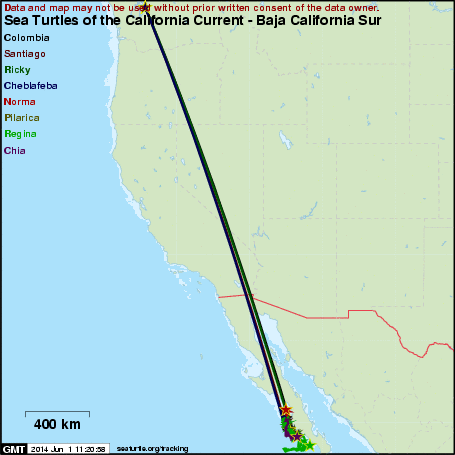
Introduction
Project Background (English)
Loggerhead turtles connect the ecosystems and cultures of the Pacific Rim through their migrations; as juveniles they travel from Japan to Mexico via the Hawaiian archipelago, and at maturity they return to their Japanese nesting beaches to reproduce. These Pacific ambassadors gather for decades at Baja California Surâs Gulf of Ulloa to feed and mature. Off Puerto Lopez Mateos, they forage especially close to shore where artisanal gillnet and longline fishing is intense. This unfortunate overlap of fishing and foraging results in severe loggerhead bycatch.
Olive ridley turtles also aggregate in the Gulf of Ulloa to forage on the same richness as the loggerheads. Olive ridleys nest on the Pacific coast of mainland México and to a limited extent on the southern shores of the Baja California peninsula. But though olive ridleyâs are present at similar densities as loggerheads in the Golfo de Ulloa, foraging on similar prey and at similar depths, they are caught only rarely in fishing gear.
Grupo Tortugueroâs Proyecto Caguama (Operation Loggerhead) has partnered with fishermen and other costenos to augment the sustainability of their fisheries since 2003. As a result of these long-term partnerships, local fisher leaders have voluntarily made changes in fishing gear and practice that have in turn spared hundreds of loggerhead turtles each year since 2007, representing a major conservation achievement.
In 2011 and 2012 Grupo Tortuguero with local fihsing partners will be investigating differences in foraging ecology between loggerhead and olive ridley turtles in the Gulf of Ulloa. Are they really eating the same prey? Do they move and dive differently? Do they use different microhabitats that differentially expose them to fishing gear? Answering these questions using new, high precision satellite telemetry coupled with dive loggers and stable isotopes will enable the Grupo Tortuguero and partners to pinpoint and protect loggerhead critical habitat and to further enhance the selectivity of fishing gear to minimize turtle bycatch.
The Grupo Tortugueroâs fisheries sustainability program including ProCaguama has been generously funded by CONABIO, the Walton Family Foundation, the Helmsley Trust, and the David and Lucille Packard Foundation. The research described here has has been made possible by the WWF â Telcel Alliance and NOAAâs Southwest Fisheries Science Center.
Project Partners
Project Leaders
Hoyt Peckham PhD, Grupo Tortuguero de las Californias
MC Juan Manuel RodrÃguez Baron, Grupo Tortuguero de las Californias
Biol. Mar. Barbara Cardoso, Grupo Tortuguero de las Californias
Capt. Jesus Lucero Romero, Grupo Tortuguero de las Californias
Jeffrey Seminoff PhD, NOAA Fisheries
Project Sponsors
Grupo Tortuguero de las Californias
NOAA Southwest Fisheries Science Center
WWF-Telcel Alliance
