seaturtle.org :
MTN :
ARCHIVES :
Sign In
Marine Turtle Newsletter 66:8-9, © 1994

Sea Turtle Strandings Along the Texas Coast Reach Alarming Levels
Donna J. Shaver
National Biological Survey, National Wetlands Research Center,
Padre Island National Seashore, 9405 S. Padre Island Drive,
Corpus Christi, Texas 78418 USA
Two hundred and forty-six sea turtles were documented stranded along the Texas coast from 1 January to 31 May 1994. Included in the 246 were 19 head-started Kemp's ridley turtles (Lepidochelys kempi). The number of wild turtles that stranded during the first five months of 1994 (n=227) has already exceeded the number stranded during the entire year for 1991 (n=176), 1992 (n=160), and 1993 (n=185). Of great concern is the high number of stranded Kemp's ridleys. Among the 227 wild turtles that stranded this year were 140 Kemp's ridleys, 66 loggerheads (Caretta caretta), 14 greens (Chelonia mydas), three leatherbacks (Dermochelys coriacea), one hawksbill (Eretmochelys imbricata), and three turtles of unknown species. Although most of the individuals documented were juveniles and subadults, a few adult loggerhead and Kemp's ridley turtles were found (Figure 1). Only 11 wild sea turtles were found stranded along the Texas coast from January through March. However, strandings increased dramatically in early April and continued at high levels until mid-May, with 102 turtles documented in April, 92 from May 1-14, and 22 from May 15-31. In comparison, during 1991, 1992 and 1993, April strandings ranged from 12-28 and May strandings from 8-16.
A number of theories have been proposed regarding causes of the sea turtle strandings along the Texas coast this year. It has been theorized that the turtles were killed by
- a virus implicated in dolphin strandings along the Texas coast;
- red or brown tide, perhaps via ingestion of dead prey items;
- toxic wastes or pollution;
- hydrological conditions;
- fisheries operations, including shrimping, menhaden fishing, and illegal gill netting.
The National Marine Fisheries Service and U. S. Coast Guard reported that Turtle Excluder Devices (TEDs) were installed on 95% of shrimping vessels boarded; however, it is possible that some of the TEDs were not installed properly and/or they malfunctioned. Along the lower Texas coast, strandings were most numerous when shrimping effort was the highest. Strandings diminished considerably throughout the state after the shrimping closure in offshore waters began on May 13.
Necropsies were performed on nearly all of the turtles found. However, since most of the turtles were decomposed when located, cause of death could not be ascertained for the majority of individuals. Gastrointestinal tract contents from many of the turtles are being examined. Similarly, tissue samples collected from a selection of comparatively fresh carcasses are being analyzed for contaminants. Investigations into causal factors are ongoing. Many people from a variety of government agencies and private organizations have cooperated to document and investigate the strandings. These agencies and organizations include the Sea Turtle Stranding and Salvage Network, National Marine Fisheries Service, National Park Service, National Biological Survey, Texas Parks and Wildlife Department, University of Texas at Austin Marine Sciences Institute, University of Texas at Pan American, Marine Mammal Stranding Network, Center for Marine Conservation, and Help Endangered Animals-Ridley Turtles (H.E.A.R.T.).
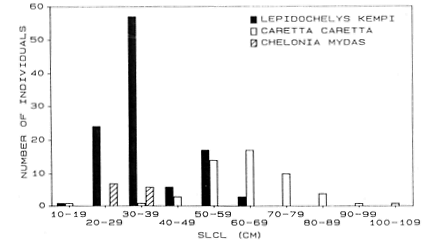
Figure 1
. Straight-line carapace lengths of Lepidochelys kempi (n=108), Caretta caretta (n= 52) and Chelonia mydas (n=13) found stranded on the Texas coast, 1 January - 26 May 1994.