seaturtle.org :
MTN :
ARCHIVES :
Sign In
Marine Turtle Newsletter 101:35-36, © 2003

Report from the Tagging Workshop at the 23rd Symposium on Sea Turtle Biology and Conservation, Kuala Lumpur, Malaysia
Matthew H. Godfrey1, Lisa M. Campbell2, Brendan J. Godley3 & Nicholas J. Pilcher4
1Wildlife Resources Commission, 307 Live Oak St., Beaufort, NC 28516 USA (Email: godfreym@coastalnet.com)
2Department of Geography, University of Western Ontario, London, Ontario N6A 5C2 Canada
(Email: lcampbe@uwo.ca)
3Marine Turtle Research Group, School of Biology, University of Swansea Swansea,
Wales SA2 8PP United Kingdom (Email: mtn@swan.ac.uk)
4Community Conservation Network, PO Box 1017, Main St., Koror, Koror 96940 Palau (Email: pilcher@ tm.net.my)
Marking or tagging sea turtles is a cornerstone of many conservation and research projects. Being able to recognize and follow individual turtles can provide details on many aspect of chelonian life history including migration, growth, age at maturity, and reproductive behaviour (Balazs 1999). The application of tags is so common in sea turtle monitoring programs that there have been suggestions that some tagging is mere “reflex” (e.g. Mrosovsky 1982). Nevertheless, tagging sea turtles has and will continue to reveal a wealth of information regarding sea turtles.
The diversity in types and applicability of tags for sea turtles has grown in recent years, and in order to facilitate a sharing of knowledge and experience amongst the sea turtle conservation community, a workshop on tagging was held during the annual International Sea Turtle Symposium (17-21 March 2003) in Kuala Lumpur, Malaysia. For this particular workshop, we concentrated on the three most commonly used types of tags: metal alloy flipper tags, internal Passive Integrated Transponder (PIT) tags, and Platform Terminal Transmitters (PTTs), otherwise known as satellite tags. Other types of tags (e.g. living tags, internal chemical tags, or genetic tags) were not discussed, due to time and logistic constraints. In addition, analysis of tagging data (including estimating and accounting for tag loss) was given only cursory recognition at this workshop; future fora should address these important issues.
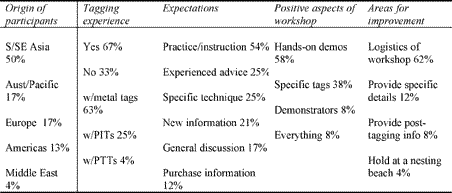
Table 1. Responses of survey questionnaire to participants of the Tagging Workshop. Forty questionnaires were distributed and 24 were returned with answers (60% response rate).
The workshop was divided into two main parts: the first half was moderated by Brendan Godley and included overview presentations by Duncan Limpus (metal flipper tags), Matthew Godfrey (PIT tags), and Catherine McClellan (PTTs on hardshells), with supplemental information from Brendan Godley (on behalf of Scott Eckert and Graeme Hays), Steven Morreale and Anders Rhodin (PTTs for leatherbacks). The second half of the workshop included 8 different stations for hands-on demonstrations. Catherine McClellan, Nicholas Pilcher, Wendy Cluse and Jeff Seminoff demonstrated general methods for the adhesive application of PTTs directly to hard-shelled turtles while Brendan Godley demonstrated a harness-type attachment of a PTT for leatherbacks. Larisa Avens, Michael Coyne and Matthew Godfrey explained the two main types of PIT tags and scanners (Trovan and Avid-Destron), and participants were able to inject/scan PIT tags in mock turtle flippers. Duncan Limpus, Mark Hamman and Bryan Wallace instructed participants on the different types of metal flipper tags and the different tagging locations on mock front flippers. Handouts and information pamphlets were also available to all participants.
One of the planned outcomes of this workshop is the creation of a tagging information link on <https://seaturtle.org/tagging/> that will include downloadable copies of the presentations and handouts available in Kuala Lumpur; look for future announcements regarding when this will be available online. In addition, a survey of the expectations and comments of participants was administered (Table 1). Feedback on the workshop was generally positive, with more comments received on the helpful aspects of the workshop than on areas for improvement. Most attendees expected to learn new techniques and/or gain knowledge through access to experienced taggers during the demonstrations. A majority (58%) did find the presented information/demonstrations useful and informative, suggesting a successful workshop. Respondents also indicated that some of the set-ups, for example the mock flippers, were probably not realistic enough for proper training, and were disappointed with lack of sufficient time available during the workshop. Our original intention had been to keep the workshop small, which may have addressed some of the logistical problems. We recognize that the best way to learn how to apply a specific type of tag is to have someone experienced demonstrate this on an individual basis. Nevertheless, the high attendance at this event suggests that a smaller workshop would have excluded many eager participants.
Acknowledgements: This workshop could not have been possible without the generous support and donations of various manufacturers and distributors of the different kinds of tags, including Brenda Burger (Telonics, USA), Michael and Anna Forehan (Stockbrands Pty Ltd, Australia), Eric Haas (National Band and Tag Co., USA), Kevin Lay (Sirtrack, New Zealand), Mark Owens (BioMark USA), Roland Stump (Trovan Inc., Netherlands). We are also grateful to the creative powers of Catherine McClellan and Carmen Pilcher for making the mock carapaces and flippers, to Peter Richardson and Sue Ranger for providing the inflatable leatherback to demonstrate the harness attachment, and to Michael Coyne, in agreeing to provide web space on seaturtle.org for the workshop’s accessible materials. Thanks to Jack Frazier for constructive advice during the meeting.
BALAZS, G.H. 1999. Factors to consider in the tagging of sea turtles. In: K.L. Eckert, K.A. Bjorndal, F.A. Abreu-Grobois & M. Donnelly (Eds). Research and Management Techniques for the Conservation of Sea Turtles. IUCN/SSC Marine Turtle Specialist Group Publication No. 4. pp. 101-109.
MROSOVSKY, N. 1983. Conserving sea turtles. British Herpetological Society, London. 176 pp.