Marine Turtle Newsletter 68:15-18, © 1995

A Traditional Fishery of Leatherback Turtles in Maluku, Indonesia
Martha Suarez and Christopher Starbird
12801 Graton Road, Sebastopol, California 95472 USA
seaturtle.org : MTN : ARCHIVES : Sign In
Marine Turtle Newsletter 68:15-18, © 1995
Martha Suarez and Christopher Starbird
12801 Graton Road, Sebastopol, California 95472 USA
The Kei Islands are located southwest of New Guinea in the Maluku province of Indonesia (5°43'S, 132°50'E). The archipelago was historically renowned for its natural diversity and beauty (Wallace, 1989), but has been subjected to intensive timber harvest during the last three decades. Many of the islands have been deforested, and local inhabitants subsist primarily on agriculture and marine resources, including turtles. Of the five species of sea turtles found in the waters of Maluku, the olive ridley and the loggerhead are encountered least often. Green turtles and hawksbills nest within the archipelago, but their numbers have been severely reduced due to poaching of nesting females, incidental capture in gill nets, take by skin-divers using treble hooks, and the collection of eggs. Leatherbacks do not nest on the islands, but are hunted in the open sea (Figure 1). The nearest leatherback nesting area is on the north coast of Irian Jaya, some 1000 km away by sea (Bhaskar, 1987). With the exception of leatherback meat, which remains within the hunters' villages, turtle meat is both consumed locally and sold in Tual on the north coast of Kei Kecil. Hawksbill shells are sold to buyers from Tual, Ambon and Jakarta who visit the remote villages in the Kei Islands regularly in search of the shells for export.
Leatherbacks frequent the waters (200-3000 m depth) off the southwestern coast of Kei Kecil throughout the year. We watched them feeding on abundant surface scyphomedusae, and six necropsies conducted during our study suggest these to be their main prey (results to be published elsewhere). In an effort to describe the traditional leatherback fishery, which has existed in this area for centuries (Compost, 1980), we interviewed fishermen, village chiefs and elders in eight villages on Kei Kecil and the adjacent islands of Ur, Warbal and Tanimbar during 2 October-13 November 1994. Interviews were standardized to determine the number of leatherbacks killed annually, traditional beliefs associated with the fishery, and hunting methods and sites. Sabtu Ohoirat, an Indonesian university student from Kei Kecil, assisted us with translation and an environmental education workshop in Ohoidertutu village. Hunting methods and rituals were studied further by accompanying hunting boats from two villages. During informal meetings and discussions, we shared sea turtle research techniques and ecological information with village chiefs and hunters in eight villages, and then hired them to collect data (e.g., number, species, size) on the turtles harvested by their villages through the end of 1994.
Approximately 200 leatherbacks are harpooned southwest of Kei Kecil (Figure 1) from October to December, the local oceanic calm period. Eight villages participate in the hunt using traditional harpoons and dugout sailboats. Five villages (Ohoidertutu, Matwaer, Ohoidertom, Somlain, Ohoiren) are located on the southwestern coast of Kei Kecil; the others (Warbal, Ur, Tanimbar Kei) are on offshore islands. Eight to ten men sail a dugout boat to an area approximately 5 km from shore, and perform a ceremonial chant which is believed to attract the turtles to the boat. Once a leatherback is sighted, the sails are dropped and all men on board row towards it. A man on the bow harpoons the turtle through the carapace or neck, sometimes several times. The turtle is then pulled to the boat with a rope and clubbed over the head.
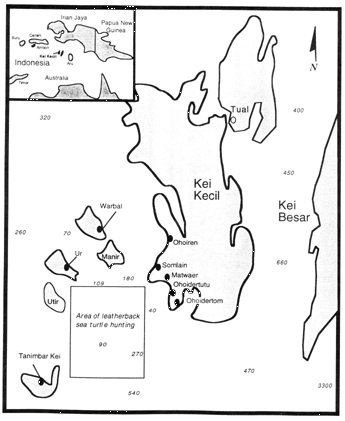
Figure 1. Location of traditional leatherback turtle fishery in Maluku, Indonesia (not to scale).
Interview data suggest that both adult male and female leatherbacks are taken. During our study we witnessed six adult females taken by Ohoidertutu village in two weeks, all carried undeveloped eggs approximately 3 cm in diameter. The average curved carapace length and width was 154 cm (range 145-164 cm) and 107 cm (range 103-113 cm), respectively, for these six turtles. As many as 13 leatherbacks have been harpooned in one day by Ohoidertutu villagers (P. Teniwut, Chief of Ohoidertutu, pers. comm., 1994).
The harvest of leatherbacks in the Kei Islands is controlled by local law ("adat"), which encourages villagers to hunt only for subsistence and does not allow trade or sale of leatherback meat. Adat also encompasses other traditional beliefs, such as no food or water can be aboard while hunting, the harpoon must not touch the water before spearing the turtle, the hunter must remove his hat before harpooning a turtle, if a man's wife is pregnant he cannot harpoon the turtle, and the first to see the turtle during the hunt receives its head (purportedly the best meat). Adat also calls for several offerings to the gods, such as placing a 100 Rupiah coin, rice liquor, lime, sirih leaves, areca palm nuts and tobacco in a dish before going off to sea. The peoples of Kei continue to have strong ties to the traditional values of adat, despite a changing cultural and physical landscape. For now, leatherbacks are only hunted for sustenance; the meat is not sold. Under the mounting pressures of population growth and development, however, attitudes and perceptions of the environment and of leatherback hunting may change.
It is of concern that today many of the ancient adat beliefs and rituals associated with the hunt no longer persist within the villages, in even the most remote areas of the Kei Islands. This may be an indication of the onset of a breakdown in cultural values, as has occurred in other sea turtle hunting societies which have undergone rapid change in the modern era (e.g., Nietschmann, 1982). Today leatherback turtles are hunted more frequently and in greater numbers than in previous decades. This is due to an increased need for meat among the villagers, a direct result of the loss of forest resources such as deer, birds and pigs. Population growth on the islands has also contributed significantly. What began centuries ago as a highly ritualized and perhaps sustainable practice has now become a quite intensive harvest which is a necessity for sustenance in the Kei Islands. As a result, the traditions of this unique culture may be negatively affecting the status of this endangered turtle. While eliminating the hunt would remove an important food source for the Kei peoples, we believe that there is great potential to reduce the number of leatherbacks harvested.
Understanding the local tradition is an important step towards effective conservation of the leatherback turtle in the Kei Islands. Integrating the needs of the people and their traditional values into plans to conserve the turtles will prove the most effective conservation approach. With this in mind, an effective alternative might be to encourage alternative sources of protein such as pigs, goats and chickens. In Ohoidertutu village where the most leatherback turtles are harvested (70-100/yr), both the chief and sub-chief agreed that alternative sources of meat would reduce the drive to hunt leatherbacks. By providing villages with animal stock and improving husbandry skills, the need to hunt leatherbacks could be reduced significantly. Conservation initiatives should foster an understanding of the ecology and endangered status of the leatherback turtle. Through environmental education and public awareness campaigns, the villagers will gain a better understanding of contemporary dangers facing leatherback turtles. Informed choices by the peoples of Kei will help ensure sustainability by addressing the need for management of their fishery and establishing guidelines for the take of turtles (Pritchard, 1994). Through community participation and local agreement, such a conservation program will be most likely to survive and flourish in the future.
We would like to thank The Chelonia Institute (Arlington, Virginia) for financial support and Peter C. H. Pritchard (Florida Audubon Society) for moral support and guidance. Programme Lingkunkan Maluku in Ambon, Indonesia provided us with invaluable logistical assistance and in better understanding the politics of Indonesia. We hope to work together again in the future.
Bhaskar, S. 1987. Management and research of marine turtle nesting sites on the north Vogelkop coast of Irian Jaya, Indonesia. WWF Publication. 27 pp.
Compost, A. 1980. Pilot survey of exploitation of dugong and sea turtles in Aru Islands. Yayasan, Indonesia Hijau, Bogor.
Nietschmann, B. 1982. The cultural context of sea turtle subsistence hunting in the Caribbean and problems caused by commercial exploitation, p.439-446. In: K. A. Bjorndal (Editor), Biology and Conservation of Sea Turtles. Smithsonian Inst. Press, Washington D. C.
Pritchard, P. C. H. 1994. Turtles and Arawaks: a multidisciplinary conservation ethic for indigenous people in Guyana, p.120-122. In: K. A. Bjorndal et al. (Compilers), Proc. Fourteenth Annual Symposium on Sea Turtle Biology and Conservation. NOAA Tech. Memo. NMFS-SEFSC-351. U. S. Dept. Commerce. 323 pp.
Wallace, A. R. 1989. The Malay Archipelago: the land of the orang-utan and the bird of paradise. Oxford Univ. Press, NY. 638 pp.