seaturtle.org :
MTN :
ARCHIVES :
Sign In
Marine Turtle Newsletter 64:3-6, © 1994

Conservation of Sea Turtles on the Madras Coast
Kartik Shanker
Students' Sea Turtle Conservation Network (SSTCN) A1/4/4, 3rd Main Road, Besant Nagar, Madras 600 O90 India.
Present address: Centre for Ecological Sciences, Indian Institute of Science Bangalore 560012 India
Introduction: As in many populations of sea turtles the world over, various human- related activities have adversely affected the olive ridley (Lepidochelys olivacea) on the Madras coast. In India, the primary form of exploitation in many areas is the poaching of eggs. In many parts of the country, the turtle is worshipped and hence, the adult is not harmed. On the Madras coast, collection of eggs is the key problem and is linked to the socio-economics of the coastal fishing villages, who in the face of various problems turn to poaching as an alternate source of income. Other threats, including habitat destruction, beach lighting, and pollution result from urbanisation along the coast. Conservation of sea turtles on the Madras coast was initiated by Whitaker in 1973. Hatcheries were maintained by the Central Marine Fisheries Research Institute and the Tamil Nadu Forest Department. The Students Sea Turtle Conservation Network (a voluntary organisation run primarily by students) has organised a sea turtle conservation programme on the Madras coast since 1988.
Methods and Study Area: Our study area extends 30 km south of the Adyar River, Madras. The beaches are sandy with few or no rocks. The dominant vegetation includes Ipomea (creeper), Pandanus (woody plant) and Spinifex (thorny creeper). There is a fishing village every approximately 1.5 km and the density is increasing (Figure 1). The nesting season of the olive ridley follows the northeast monsoon and falls between the months of December and March. The area selected for survey and collection was patrolled on foot every night during the nesting season. The eggs were collected and relocated in a hatchery on the beach, simulating natural conditions as far as possible. Hatchlings were released immediately after emergence at the high tide line. Nests were excavated after emergence to examine dead hatchlings and unhatched eggs. In 1992-93, collection of nests was reduced to a minimum and restricted to nests found within fishing village boundaries and other such nests that had no chance of survival in the wild. Other nests were left on site, tracks were erased, and nests were monitored until hatchling emergence.
Results: Selected nests data are summarised in Table 1. Nesting was significantly higher during the last two seasons, the effort and the poaching pressure being approximately equal in all seasons (Abraham, 1989; Abraham et al., 1990; Mathew et al., 1991).
Hatchery Management: The low hatching success of the first three years (especially 1990-91) appeared related to high temperatures in the latter half of the season and to relatively large clutch sizes (Abraham et al., 1990; Mathew et al., 1991). Various methods were adopted to increase live hatchling percentages. Shading of nests during the last week of incubation increased live hatchling percentages (Mathew et al., 1991), as did the splitting of large clutches into two pits during relocation (Abraham et al., 1990; Mathew et al., 1991).
High nest density is believed to reduce hatching success (Cornelius and Robinson, 1983). In 1991-92, the size of the hatchery was increased and the average distance between nests was increased from 0.6 m (approximately 2 nests/m2) to 1.5 m (approximately 1 nest/m2). This resulted in a significantly higher hatching percentage (Mathew et al., 1991). It is therefore recommended that when hatcheries are unavoidable, care should be taken to keep nest density low (i.e., on the order of 1 nest per square metre).
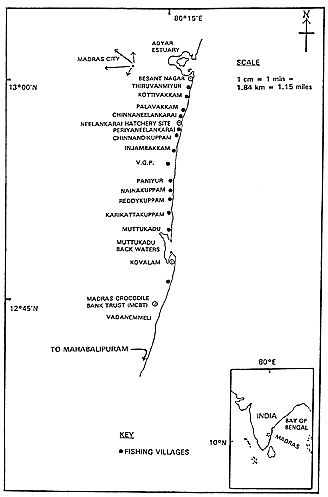
Figure 1. Map of the Madras coast, India.
When nest densities are low, organisations operating on a low budget might run into trouble. Further, very large hatcheries might pose some inconvenience to fishermen and other local inhabitants. A circular configuration is theoretically ideal as it provides the maximum enclosed area for a given length of fencing. A circle is often impractical, however, and so a regular polygon with a large number of sides (10 or 12) is recommended (Abraham et al., 1990).
Table 1. Nesting and hatchery data from four seasons, 1988-1992.
|
|
1988-1989 |
1989-1990 |
|
Recording nesting season |
24 December-23 March |
12 December-7 March |
|
Collection dates |
12 January-19 February |
13 December-7 March |
|
Nests collected |
68 |
55 |
|
Total no. of eggs |
8,625 |
6,635 |
|
Mean clutch size |
126.8 |
120.6 |
|
Hatchlings released |
5,725 |
3,838 |
|
Live hatchling percentage |
66.4 |
63.9 |
|
|
1990-1991 |
1991-1992 |
|
Recorded nesting season |
25 December-8 March |
27 December-15 March |
|
Collection dates |
25 December-8 March |
27 December-8 March |
|
Nests collected |
206 |
175 |
|
Total no. of eggs |
24,586 |
19,626 |
|
Mean clutch size |
120 |
106 |
|
Hatchlings released |
12,454 |
16,616 |
|
Live hatchling percentage |
50.6 |
84.8 |
Viable Alternatives to the Madras Hatcheries? While SSTCN shares the worldwide concern that sea turtle hatcheries may release hatchlings with skewed sex ratios due to temperature-based sex determination (with this in mind, nest and atmospheric temperatures were monitored from 1990-92), we find it difficult to envision a time when the hatcheries will not be needed in our area.
There are professional as well as opportunistic poachers on the Madras coast. The professionals have been on the coast for generations and by themselves may not pose a very serious threat as their numbers are few. The opportunists are members of the fishing villages all along the coast. The fishermen have serious problems due to competition with motorised trawlers (the fisherfolk use 'catamarans' -- logs tied together with rope) and thermal and chemical pollution. They have also been affected by changing lifestyles due to the proximity of the city. Hence, many are turning to collection of turtle eggs as a convenient extra source of income. Since fishing villages dot the entire coastline, the cumulative effect of countless opportunistic poachers is very serious.
The prospect of a long-term solution for the olive ridley on the Madras coast seems bleak. An attempt at lessening reliance on hatcheries was made in the year 1992-93 (when most nests were left in situ; see Methods), but little progress was made in terms of countering poaching. More work needs to be done over the next few years if any solutions are to be found. The coastal villages must be the focus of this work.
Acknowledgements: The SSTCN thanks the Tamil Nadu Forest Department and the Central Ministry of Environment and Forests. We also thank all the members and the numerous organisations and individuals who have helped through the years.
Abraham, C. 1989. Report on the Conservation and Management of the Sea Turtles on the Madras Coast: 1988-89 Report. Students' Sea Turtle Conservation Network.
Abraham, C., K. Shanker, and Y. Thiruchelvam. 1990. Conservation and Management of Sea Turtles on the Madras Coast: 1989-90 Report. Students' Sea Turtle Conservation Network.
Mathew, J., R. Rajagopal, and K. Shanker. 1991. Conservation and Management of Sea Turtles on the Madras Coast: 1990-91 Report. Students' Sea Turtle Conservation Network.
Silas, E. G. 1984. Sea Turtles of India - Need for a Crash Programme on Conservation and Effective Management of the Resources. Mar. Fish. Inform. Serv. No. 50.
Silas, E. G. (Editor). 1984. Proceedings of the Workshop on Sea Turtle Conservation. Cent. Mar. Fish. Res. Inst., Special Publication No. 18.
Cornelius, S. E. and D. C. Robinson. 1983. Abundance, Distribution and Movement of the Olive Ridley Sea Turtle in Costa Rica, III. Final Report to the U. S. Fish and Wildlife Service.