Marine Turtle Newsletter 61:15-18, © 2001

1991 Survey of Marine Turtles Nesting in Trinidad and Tobago
B. Godley, A. Broderick, S. Blackwood, L. Collins,
K. Glover, C. Mcaldowie, D. Mcculloch, J. Mcleod
5 Coneypark, Stirling FK7 9LU, Scotland.
seaturtle.org : MTN : ARCHIVES : Sign In
Marine Turtle Newsletter 61:15-18, © 2001
B. Godley, A. Broderick, S. Blackwood, L. Collins,
K. Glover, C. Mcaldowie, D. Mcculloch, J. Mcleod
5 Coneypark, Stirling FK7 9LU, Scotland.
Five species of sea turtle are known to nest in Trinidad and Tobago: the leatherback (Dermochelys coriacea), hawksbill (Eretmochelys imbricata), green (Chelonia mydas), olive ridley (Lepidochelys olivacea), and loggerhead (Caretta caretta) (Gyan, 1987; Chu Cheong, 1990). Only the leatherback nests in relatively large numbers. High density nesting beaches are found on the north and east coasts of Trinidad and on a few beaches in Tobago (Bacon, 1970; Gyan, 1987; Chu Cheong, 1990). Nesting by other species is reported to be largely centered along the north and east coasts of Trinidad and Tobago, as well as on the Bocas Islands (Gyan, 1987). The purpose of this paper is to present the results of a nesting survey carried out by an eight-person undergraduate team as part of the Glasgow University Conservation Expedition to Trinidad and Tobago 1991.
A detailed description of all study sites is provided by Godley et al. (1992). In summary, the project was divided between an intensive study at Matura Beach on the east coast of Trinidad and an extensive survey of turtle activity at most other nesting beaches in both Trinidad and Tobago. The 5 km beach at Matura was patrolled nightly from 29 June to 19 July 1991. Activities not observed were evaluated to be either "false crawls" or "possible missed nests". The number of observed successful leatherback nestings at Matura Beach during the study period was 67, in addition to 65 "possible missed nestings". Both green and hawksbill turtles nested in low numbers during the study period. Each nesting female was tagged on her fore-flipper with a Ketchum monel tag engraved "GLASUNI" and numbered 1-50. During one two-week interval (2-15 July), 40 individual turtles were tagged at Matura Beach, including 37 leatherbacks and three hawksbills. In addition, three nesting leatherbacks were tagged at Grande Riviere Beach on the north coast. There was only one tag return during the study and this was a leatherback which nested at Matura Beach on two occasions.
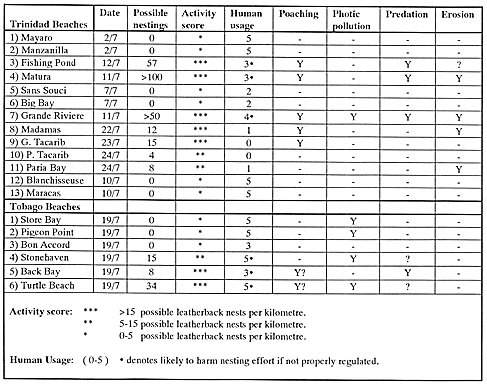
Sixty-three leatherback nests were observed to hatch during the study period; 32 were completely excavated post-hatching. Clutch size, number of yolked eggs, and hatch success were calculated. One live albino hatchling was documented at Matura Beach. This phenomenon has also been recorded elsewhere in the Caribbean (K. A. Eckert, pers. comm., 1992). In addition to the intensive study at Matura Beach, most of the northern and eastern beaches of Trinidad and those in Tobago were surveyed at least once in July to give an approximate index of activity which had occurred as of the census date. Surveys consisted of walking the beach during the day, counting possible nest sites, and making observations concerning potential threats to nest success. This information is summarized in Table 1 for major beaches with important problems.
Historically, the major problems at Matura Beach have been poaching and human disturbance, beach erosion, and natural predators. Poaching is on the decline. Bacon (1970) reported 23 leatherbacks killed in 1968 and 13 in 1969, Chu Cheong (1990) reported 14 during her 1981-1983 study, and Godley et al. (1991) reported one in 1989 and another in 1991. There have been many positive changes since 1989 in the management of Matura Beach under the leadership of Dr. Carol James of the Wildlife Section, Forestry Division. Since the 1990 turtle nesting season, beaches at Matura and Fishing Pond have been designated Prohibited Areas and volunteer wardens have been recruited. The result has been reduced poaching, an increased public awareness, and a large number of recreational "turtle watchers" visiting Matura Beach. While turtle watching brings other potential problems, this activity is well-managed at present. Erosion is still a serious concern. About 40% of the 100 "possible nest sites" recorded on 11 July were within 500 m of the Matura River; a similar situation was documented in 1989 (Godley et al., 1989). This area is highly vulnerable to erosion. If manpower were available and correct protocol used (cf. Solomon and Tippett, 1991), there is no doubt that nesting success at Matura and Grande Riviere beaches could be greatly increased by selected transplantation of eggs.
The Grande Riviere Beach was monitored for eight nights at the end of the nesting season (9-20 July). There was little nesting activity, with an average of two nests per night. Residents reported 20-plus nests per night in May and June. The main threats to nest success on this beach are erosion, predators, and beach-front lighting. Heavy river run-off caused the erosion of dozens of nests in July. Many exposed eggs were transplanted by local people, but no standard protocol was used and it is likely that hatch was low. Additional rains in August resulted in the loss of about 150 m of prime nesting habitat; many nests are sure to have been lost. There is abundant evidence that dogs consume both eggs and hatchlings. When entire clutches are not consumed, the eggs that remain desiccate in the nest or are taken by crabs and vultures. The problem of hatchlings being eaten by dogs is compounded when the hatchlings are disorientated at night by beach-front lighting.
Table 1. Information gathered during daytime surveys of selected sea turtle nesting beaches in Trinidad and Tobago, July 1991.
Lighting from rest house and chalet-type accommodations built on Grande Riviere Beach is sufficient to attract newly emergent hatchlings toward the light source. This is particularly unfortunate because the lights affect a large part of the most favored nesting slopes. The owners are not averse to the needs of the turtles; indeed, many are rescued and returned to the sea. It should be a major priority of any management plan to advise residents on the installation of lighting that does not shine directly on the beach. It is worth noting that poaching was once high at Grande Riviere, but there were no slaughters in 1991. We were assured by local people that the poachers were usually outsiders and that a group of them had already been thwarted that year by the action of local youths. There is a deep feeling that the turtles are part of the village heritage. This was evident at a meeting, which we attended, between the villagers and Wildlife Section (Forestry Division) staff on the subject of training ecotourism guides who would function as honorary wardens, as occurs at Matura Beach.
In summary, we estimate that a minimum of 300 leatherback nests were laid in Trinidad by the end of July 1991, and at least 50 nests in Tobago. Approximately half of all possible nests in Trinidad were on Matura Beach, where at least 37 individuals nested and were tagged. Green and hawksbill turtles nested in low concentrations. Our data do not permit an estimate of population size, but we can conclude that despite extreme exploitation in the recent past, there is still a sizable and regionally important nesting population of leatherback turtles at Matura Beach and elsewhere in the country. The future for marine turtles in Trinidad and Tobago seems better than it did just ten years ago. Poaching is down, nesting is up, and public awareness and conservation action on the part of the government are increasing. Funding for wardens and long-term intensive research and monitoring are lacking, however. Continued enforcement of existing conservation laws protecting turtles should be priority on both islands, and comprehensive monitoring initiatives are needed to provide baseline data against which to evaluate the effectiveness of ongoing conservation efforts.
Acknowledgements: The expedition as a whole was funded by Glasgow University Court, British Ecological Society, Carnegie Trust for Universities of Scotland, Cross Trust, Royal Geographical Society, Biological Council, and The Gilchrist Trust. Brendan Godley would like to acknowledge additional support from The Youth Activities Fund of the Explorers Club of New York, Dale Carnegie Training, The Mary Elizabeth and Andrew Little Trust, and Mr. Vince Godley. We would also like to acknowledge help provided by the Wildlife Section, Forestry Division (Government Trinidad and Tobago), Dr. J. R. Downie, Maggie Reilly, Dr. S. E. Solomon, Dr. R. Tippett, Dr. K. Eckert, Dr. S. Eckert, Mr. Fahey, Mr. Mackay, Tony Doug Deen, Daria St. Hill, and Michael Moraes.
Bacon, P. R. 1970. Studies on the leatherback turtle (Dermochelys coriacea) in Trinidad, West Indies. Biol. Cons. 2(3):213-217.
Chu Cheong, L. 1990. Observations on the nesting population of leatherback turtles (Dermochelys coriacea) in Trinidad. Carib. Mar. Stud. 1:48-53.
Godley et al. 1991. Leatherback Turtles in Trinidad. Marine Turtle Newsletter 52:16-17.
Godley et al. 1992. Studies on Marine Turtles Nesting in Trinidad and Tobago, p.1-19. In: Report of the Glasgow University Conservation Expedition 1991, Section 4 (J. R. Downie and M. Reilly, Editors).
Gyan N. (Editor). 1987. National Report prepared for the Second Western Atlantic Turtle Symposium. October 1987, Mayaüez, Puerto Rico. (unpubl.)
Solomon, S. E. and R. Tippett. 1991. A management plan to increase the hatchability of marine turtle eggs. Zoology Department, Glasgow University. (unpubl.)