Marine Turtle Newsletter 54:10-12, © 1991

Sea Turtle Nesting in Sierra Leone, West Africa
Jacques Fretey and Jean-Pierre Malaussena
Fédération française des Sociétés Sciences naturelles,
57 rue Cuvier, 75231 Paris cedex 05, France
seaturtle.org : MTN : ARCHIVES : Sign In
Marine Turtle Newsletter 54:10-12, © 1991
Jacques Fretey and Jean-Pierre Malaussena
Fédération française des Sociétés Sciences naturelles,
57 rue Cuvier, 75231 Paris cedex 05, France
We still know very little about the status of sea turtles in West Africa. Loggerheads, Caretta caretta (Williams 1968), green turtles, Chelonia mydas (Parsons 1962; Pharff 1964, 1967), and hawksbills, Eretmochelys imbricata (Loveridge and Williams 1957; Pharff 1964, 1967) are reported from Sierra Leone, but, according to Brongersma (1982), only the green turtle would be expected to nest there. One of us (JPM) visited Sherbro Island and the Turtle Islands (Sierra Leone) in January 1991 and was able to explore the beaches by night, as well as to interview the local fishermen. No turtles were observed nesting, but recent turtle tracks were noticed. On Yele Island, there were two green turtle tracks. On the long beach of Sherbro Island, between Cape St. Ann and Kobo, the tracks of an estimated ten green turtles and four leatherbacks, Dermochelys coriacea, were observed (among the latter, one was noticed near Cape St. Ann and three were from Tisanus, 4 km eastward). On Baki Islet, olive ridley (Lepidochelys olivacea) hatchlings have been seen (Figure 1).
The fishermen from Baki Islet contend that they sometimes see as many as 20 green turtles per night on the beach, and occasionally one or two leatherbacks. A man from Sherbro Island confided that the nesting period coincides with the wet season; that is, between September and November. The leatherback is known locally as kong, kundor kond; the green turtle as kekor kekele. Leatherback meat is said to provide "great energy" to those who consume it, but some island residents refuse it because it smells foul. The nests are regularly poached and we could get a few leatherback eggs from a man who was selling them boiled. This is further evidence that this species does indeed nest on Sherbro Island.
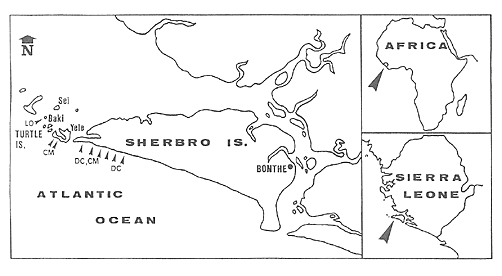
Figure 1. Nesting sites of green, leatherback, and olive ridley sea turtles in Sierra Leone, West Africa, in 1991.
Nesting by Dermochelys in this region of West Africa (Grain Coast) had previously been documented in Liberia (Büttikofer 1890; Brongersma 1970), but was unreported in Sierra Leone until now. This discovery corroborates our hypothesis that nesting by this species extends all along the Atlantic coast from Mauritania south to Angola.
Brongersma, L. D. 1970. Miscellaneous notes on turtles, III. Proc. Kon. Nederl. Akad. Wet., Amsterdam 73:323-335.
Brongersma, L. D. 1982. Marine turtles of the eastern Atlantic Ocean, p.407-416. In: Biology and Conservation of Sea Turtles (K. A. Bjorndal, ed.). Smithsonian Inst. Press, Washington D. C.
Büttikofer, J. 1890. Reisebilder aus Liberia, I. Leiden, E. J. Brill.
Loveridge, A. and E. E. Williams. 1957. Revision of the African tortoises and turtles of the suborder Cryptodira. Bull. Museum Comparative Zoology 115:163-557.
Parsons, J. J. 1962. The Green Turtle and Man. University of Florida Press, Gainesville.
Pharff, P. 1964. P. Pharff en zonen, Sierra Leone: in zeeschildpadden en barracuda's. Vers van't Vat (Heinekens Brouwerijen Nederland), 15th year, 107:14-17.
Pharff, P. 1967. De wonderlijkste vangst van mijn leven. Tussen de Rails, Maandbl. Nederl. Spoorwegen, 16:48-49.
Williams, F. 1968. General report on the Guinean trawling survey, I. Lagos, Nigeria. 828 p.