Marine Turtle Newsletter 52:8-11, © 1991

New Records of Marine Turtles in Chile
Mark Chandler
Department of Biology, McGill University, 1205 Docteur Penfield Avenue,
Montreal, PQ, Canada H3A 1B1
seaturtle.org : MTN : ARCHIVES : Sign In
Marine Turtle Newsletter 52:8-11, © 1991
Mark Chandler
Department of Biology, McGill University, 1205 Docteur Penfield Avenue,
Montreal, PQ, Canada H3A 1B1
Chile is characterized by colder waters than are usually thought to attract marine turtles, yet records of turtle catches are many. In contrast with fishermen in northwestern South America, Chilean fishermen often keep as adornments the carapaces of turtles they catch (pers. obs.) and from these "records" one can deduce something about marine turtles present along the Chilean coastline. Because there has been some confusion as to the species commonly found in Chilean waters, I believe that these records are of interest. Data were collected during a trip along the Chilean coastline from January to April 1988.
Chile can be divided into four regions: the north, central, south, and offshore islands. In my study the northern section was represented by the ports of Arica, Iquique, and Antofagasta (Figure 1). Of the nine confirmable reports of turtle catches in this section, six were green turtles (Chelonia mydas agassizi), two were leatherbacks (Dermochelys coriacea), and one was an olive ridley (Lepidochelys olivacea). Several local biologists report that the olive ridley is the most common turtle in the North. The mouth of the river Loa Loa, situated between Iquique and Antofagasta, has unusually warm waters for the region during the summer and groups of green turtles feed here. There were rumors that nesting occurred around the Chipana region in the north in the past, but I was unable to find evidence to support this and do not think it likely.
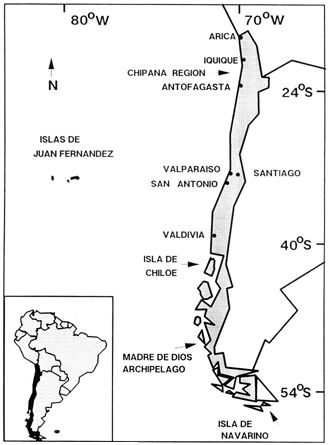
Figure 1
. Locations visited during a survey of the Chilean coastline, January to April 1988.In the central section (ranging from Valparaiso to Valdiva), there are several reports of leatherback turtles being caught. According to biologists in two of the ports, San Antonio and Valdivia, leatherbacks are caught fairly frequently. At least ten were brought in at one of the small ports near Valdivia during the first three months of 1988; one of them carried a tag from Costa Rica. Frazier and Brito Montero (1990) reported on the capture of Dermochelys by the swordfish fishery at the port of San Antonio, and estimated that some 250 individuals were caught there annually.
The only new confirmed records from the southern section of the country are those of green turtle carapaces in the possession of local fishermen. A green turtle carapace was found on Guarello Island in the Madre de Dios archipelago (about 50¡ S) and another on the island of Navarino (50° S, 67°50 W), the latter being the furthest south that a marine turtle has been reported. Apparently green turtle carapaces are occasionally found in houses on the island of Chiloe, as well.
Finally, unidentified species of marine turtles have been reported from Easter Island (27°S, 109°W) and from the Juan Fernandez Islands; I was told that leatherbacks are frequently caught near the Juan Fernandez Islands. Carapaces have also been found in the Coleccion Zoologico Flaminio Ruiz in Santiago. I found one leatherback, four green turtles, two olive ridleys, and one loggerhead (Caretta caretta) there. While none of the specimens had information pertaining to the location of collection, it seems reasonable to assume that the large and bulky shells were of Chilean origin (as opposed to having been transported from a distance). If this is true, then the loggerhead in the collection is the third one reported south of the Equator along the Pacific coastline.
Green turtles seem to be the most abundant turtle species along the coastline (Frazier and Salas 1984). In contrast, despite some documentation suggesting that olive ridleys are common in the north (Cardenas and Stutzin 1985), I have not been able to confirm these reports and do not believe that the ridley is common. Some observers have been confusing ridley and green turtles (pers. obs.). My own extensive survey of the Peruvian coastline did not reveal substantial numbers of olive ridleys and it seems unlikely that anything other than an extreme extension of migrants from the feeding area occurs in Chile. The occurrence of loggerheads along the Chilean coastline is still a mystery. Donoso-Barros (1966) claimed that loggerheads were common in the north and that a fishery existed for them. However, there is no evidence to support this (Frazier and Salas 1984) and the most likely explanation is that green turtles were mistaken for loggerheads.
The increase in leatherback records along the center of the coastline may be due to increased vigilance in the ports, a change in fishing habits (Frazier and Brito Montero 1990), or perhaps the leatherbacks have shifted their foraging range to include this new area. I believe that all three factors have played a role. It will be difficult to obtain an accurate estimate of the leatherback population off the coast of Chile because of the uneven distribution of fishermen and their habits, however it seems that Chile may be an important feeding ground for the species. It is likely that the leatherbacks in Chile derive largely from Costa Rica nesting stock; there is no evidence to support claims of nesting in Chile (Frazier and Salas 1982; pers. obs.).
To summarize, Chilean fishermen catch green sea turtles in the northern regions and leatherbacks along the central coastline of the country. Despite local myths that killing turtles will bring bad luck, many turtles are apparently killed and consumed by fishermen. The presently large populations of green turtles may not be immediately threatened by this, but it is of concern in light of the large green turtle harvest in Peru of the same population that nests in Ecuador. The leatherback fishery is of concern because neither the extent of the catch nor the size of the population is known.
CODEFF [Comite Nacional Pro Defensa de la Fauna y Flora], a Santiago based organization and the largest conservation group in Chile, is incorporating marine turtles into their marine mammal sighting network along the coast. They would appreciate any information concerning marine turtles in the South East Pacific. Please contact them at: CODEFF, Red Tortugas Marinas, Casilla 3675, Santiago, Chile. I would like to thank Juan Carlos Cardenas of CODEFF, and Ramon Formas and Carlos Guerra for kindly providing information.
Cardenas, J. C. and M. Stutzin. 1985. Informe Tecnico 4, CODEFF (Chile).
Donoso Barros, R. 1966. Reptiles de Chile. Universidad de Chile. Santiago.
Frazier, J. G. and Brito Montero, M. A. 1990. Incidental capture of marine turtles by the swordfish fishery at San Antonio, Chile. Marine Turtle Newsletter 49:8-13.
Frazier, J. G. and Salas, S. 1982. Tortugas marinas en Chile. Bol. Mus. Nac. Hist. Nat. Chile. 39:63-73.
Frazier, J. G. and Salas, S. 1984. Tortugas Marinas del Pacifico Oriental: El recurso que nunca acabara? Symp. Conser. Manejo Fauna Sil. Neo. IX CLAZ Peru:87-98.