seaturtle.org :
MTN :
ARCHIVES :
Sign In
Marine Turtle Newsletter 50:6-8, © 1990

New Legislation to Protect Sea Turtle Nesting Areas in Turkey: Patara, the Goksu Delta, and Ekincik
Clare Whitmore, Gürdogar Sarigül, and Nergis Yazgan
WWF Project 3582 - Marine Turtles, Society for the Protection of Nature (DHKD), P. O. Box 18, 80810 Bebek, Istanbul, Turkey
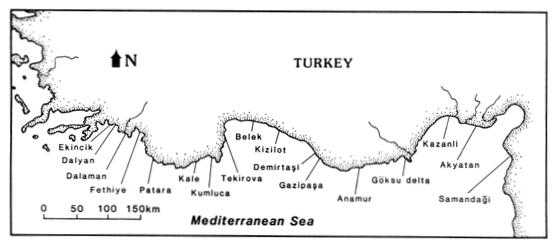
On 3 March 1990, three sea turtle nesting areas on the Turkish coast (Patara, the Goksu Delta, and Ekincik) were designated as Specially Protected Areas (SPA) by the Official Gazette of the Turkish Government, No. 20449. These will now have the same protection as Dalyan and Fethiye, two nesting areas designated SPAs in 1988. The Dalyan SPA has been extended under the recent legislation to include the whole of the Koycegiz Lake. The SPA designation now applies to five of the 17 areas identified as important sea turtle breeding areas by the DHKD-WWF-EEC survey of the Turkish coast (Figure 1, Baran and Kasparek 1988). The survey noted that the areas were threatened by various activities including sand mining and development for tourism.
The protection given to SPAs under Turkish law has yet to be aligned with the status of SPAs under the Barcelona Convention, to which Turkey is a signatory. One of the first three Turkish SPA to become statutory was created at Dalyan in 1988. The official definition of the Turkish SPA requires that:
- The natural resources within the SPA be protected from the negative impacts of human activity,
- All development and management plans for the area must be revised,
- The area will be managed in accord with international agreements and Turkish environmental law, and
- The Directorate of SPA will be fully responsible for all environmental issues within the designated area.
Despite the new legislation, the question remains as to how effective it will be in practical terms. Since its designation, the practical results of the SPA in Dalyan have been the strict prohibition of any development in the beach area (although development in the nearby village of Dalyan has continued) and the control of nocturnal beach access during the nesting season. The implementation of these regulations rests with the newly formed Directorate for SPA in Ankara.
In 1989 the Society for Protection of Nature (DHKD) aided the Directorate of SPA by carrying out a public education programme at Dalyan. Posters, leaflets and videos explaining the status of the sea turtles and the measures taken to protect them were displayed at information kiosks. Signs outlining beach use regulations were erected at beach access points. The tourists responded by not sinking umbrella poles into the sand in areas demarcated as nesting areas, not disturbing turtles on the beach at night, and in general supporting the protection efforts (Sarigül, 1989).
The newly designated SPAs have experienced serious threats to their ecologies. The nesting beach at Patara has been under threat by severe disturbance from hotel and holiday house development in the village and from unmanaged use of the beach by growing numbers of tourists (Wood, 1990). Wetland areas and archaeological sites at Patara have also been threatened because of their use as construction sites and dumping grounds for refuse. On the Goksu delta, illegal hunting, the spread of holiday homes, and large-scale sand extraction has endangered the wildlife and habitats of the sandy coast and marshy areas (Baran, 1990). In addition to being an important sea turtle nesting area, the delta is also one of the most important wetlands for birds in the Middle East. Finally, Ekincik had been designated as a tourism development area.
The difficult task of ameliorating these problems will now be the responsibility of the Directorate of SPA in Ankara. As a newly formed government agency the Directorate does not yet have its own field workers. Moreover, there is not as yet an established network for co-operation between the SPA and the various governmental departments responsible for the environment (e.g., the Ministry of Agriculture, Forestry and Rural Service, and the Undersecretariat for Environment). The small staff of the Directorate of SPAs must be increased before the preservation of the SPAs can be assured. However, their designation means that there is now a legal requirement that all construction within the new SPA areas must be halted and all physical planning revised as from 3 March 1990.
Akyatan, another sea turtle nesting area identified in the 1988 survey, is currently being proposed for protection. The Ministry of Forestry (OGM) is proposing to extend the area of the current Strict Nature Reserve (SNR) at Akyatan to include the nesting beach and nearby feeding areas at Yumurtalik Dalyan. The remaining undesignated 11 nesting areas are still under threat from development and often from large scale sand mining. In the Official Gazette of the State Planning department of the Turkish Government (Reg. No. 0327, 1989), a commitment was stated to a long term programme to protect all of the 17 areas. This was followed on 17 April 1990 by a new Littoral Law banning all sand mining and imposing a fine of up to US$ 20,000 on offenders. This Law has yet to be enforced and sand mining is currently continuing.
The designation of the new SPAs is an excellent step toward successful preservation of sea turtles in the Mediterranean and a pioneering accomplishment for wildlife conservation in Turkey. This act by the Turkish Government deserves acknowledgement from the international conservation community, and encouragement for continued efforts.
Baran, I. 1990. Sea turtles in Turkey. Marine Turtle Newsletter 48:21-22.
Baran, I. and M. Kasparek. 1988. Marine turtles in Turkey: status survey 1988 and recommendations for conservation and management. WWF (ISBN 3-925064-07-9).
Sarigul, G. 1989. Final report on Dalyan Protection and Education Project 1989. Report to the Board of the Society for the Protection of Nature (DHKD), Istanbul.
Wood, P. 1990. Environmental impact assessment of development at Patara. Bachelor of Science thesis, Univ. of Stirling, Scotland, U. K.